Showing posts with label Probability. Show all posts
Showing posts with label Probability. Show all posts
The past is a foreign country
The past is a foreign country; they do things differently there.” ― L.P. Hartley,

Huygens: The Rationale of Games of Chance

Huygens
References
De Ratiociniis in Ludo Aleae (page 521ff)
Natura quidem suas habet consuetudines
Utilissima est aestimatio probabilitatum quanquam in exemplis juridicis politicisque plerumque non tam subtili calculo opus est, quam accurata omnium circumstantiarum enumeration. Haec a Te tractata non primum a Dno. Fratre Tuo, sed aliunde me discere memini. Cum Empirice aestimamus probabilitates per experimenta successuum, quaeris an ea via tandem aestimatio perfecta obtineri possit. Idque a Te repertum scribis. Difficultas in eo mihi inesse videtur quod contingentia seu quae ab infinitis pendent circumstantiis per finita experimenta determinari non possunt; natura quidem suas habet consuetudines, natas ex reditu causarum, sed non nisi os epi to poli. Itaque quis dicet, an sequens experimentum non discessurum sit nonnihil a lege omnium praecedentium? ob ipsas rerum mutabilitates. Novi morbi inundant subinde humanum genus, quodsi ergo de mortibus quotcunque experimenta feceris, non ideo naturae rerum limites posuisti, ut pro futuro variare non possit.
Leibnizens Mathematische Schriften, Drite Folge, Driter Band. 1855 Halle. p. 83-84
References
http://cerebro.xu.edu/math/Sources/JakobBernoulli/jakob%20and%20leibniz.pdf
Leibnizens Mathematische Schriften herausgegeben von C.I. Gerhardt. Erste Abteilung, Band III, Halle. HERE.
Leibnizens Mathematische Schriften, Drite Folge, Driter Band. 1855 Halle. p. 83-84
References
http://cerebro.xu.edu/math/Sources/JakobBernoulli/jakob%20and%20leibniz.pdf
Leibnizens Mathematische Schriften herausgegeben von C.I. Gerhardt. Erste Abteilung, Band III, Halle. HERE.
Real Dice Data
- Walter Frank Raphael Weldon (1860 - 1906) performed dice rolls on 12 dice 26,000+ times. The data was used by Pearson to develop the Chi square test.
- During WWII, John Kerrich, a prisoner at a German prison in Denmark, conducted similar experiments for 10,000 throws of coins.
- In 2009, Zac Labby (Chicago), developed a machine to repeat Weldon’s experiment.
https://www.youtube.com/watch?v=95EErdouO2w
A sample from Kerrich's data from Stackoverflow:
00011101001111101000110101111000100111001000001110 00101010100100001001100010000111010100010000101101
01110100001101001010000011111011111001101100101011
01010000011000111001111101101010110100110110110110
01111100001110110001010010000010100111111011101011
10001100011000110001100110100100001000011101111000
11111110000000001101011010011111011110010010101100
11101101110010000010001100101100111110100111100010
00001001101011101010110011111011001000001101011111
11010001111110010111111001110011111111010000100000
00001111100101010111100001110111001000110100001111
11000101001111111101101110110111011010010110110011
01010011011111110010111000111101111111000001001001
01001110111011011011111100000101010101010101001001
11101101110011100000001001101010011001000100001100
10111100010011010110110111001101001010100000010000
00001011001101011011111000101100101000011100110011
11100101011010000110001001100010010001100100001001
01000011100000011101101111001110011010101101001011
01000001110110100010001110010011100001010000000010
10010001011000010010100011111101101111010101010000
01100010100000100000000010000001100100011011101010
11011000110111010110010010111000101101101010110110
00001011011101010101000011100111000110100111011101
10001101110000010011110001110100001010000111110100
00111111111111010101001001100010111100101010001111
11000110101010011010010111110000111011110110011001
11111010000011101010111101101011100001000101101001
10011010000101111101111010110011011110000010110010
00110110101111101011100101001101100100011000011000
01010011000110100111010000011001100011101011100001
11010111011110101101101111001111011100011011010000
01011110100111011001001110001111011000011110011111
01101011101110011011100011001111001011101010010010
10100011010111011000111110000011000000010011101011
10001011101000101111110111000001111111011000000010
10111111011100010000110000110001111101001110110000
00001111011100011101010001011000110111010001110111
10000010000110100000101000010101000101100010111100
00101110010111010010110010110100011000001110000111
Against Radical Empiricism - Experience needs Theory
- Experience teaches nothing without theory. (W. Edwards Deming)
- Without sensibility no object would be given to us, and without understanding none would be thought. Thoughts without content are empty, intuitions without concepts are blind (Kant, Critique Pure Reason.)
- The Sophists then appeared, men of no system but surveying all, only to find a multitude of ineffectual predicates applied to the world. (W.A. Heidel)
- A radical empiricism … denies the possibility of knowledge (Hans Reichenbach, The rise of scientific philosophy)
- no matter their ‘depth’ and sophistication, machine learning algorithms merely fit model forms to data. (Coveney, Dougherty, Highfield)
- Data have no meaning apart from their context (W. Shewhart)
- Gelman and Loken warn about the dangers of Borgean "garden of forking paths" when analyzing data. here.
References
http://rsta.royalsocietypublishing.org/content/374/2080/20160153
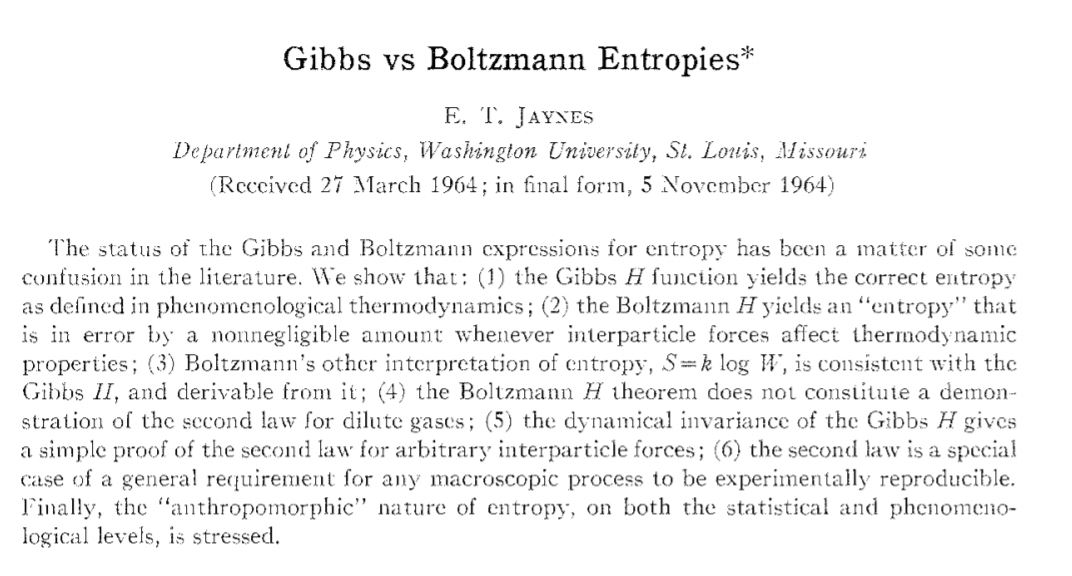
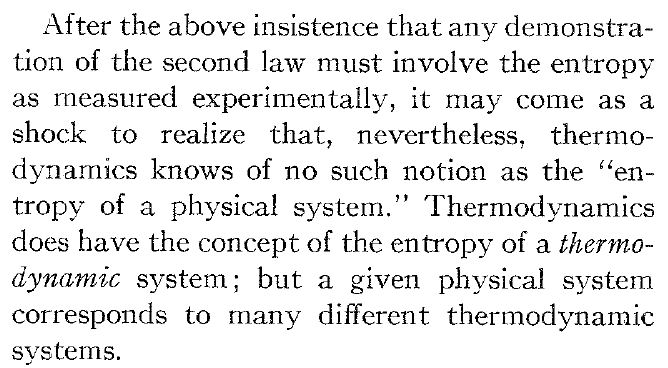
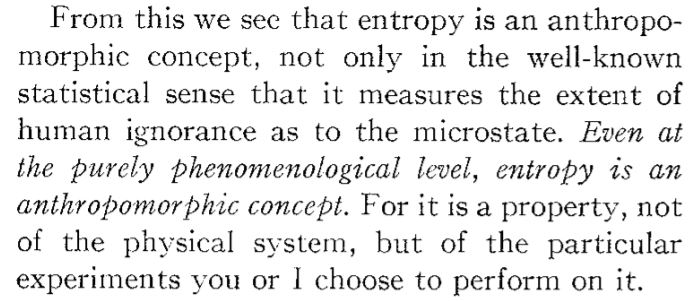
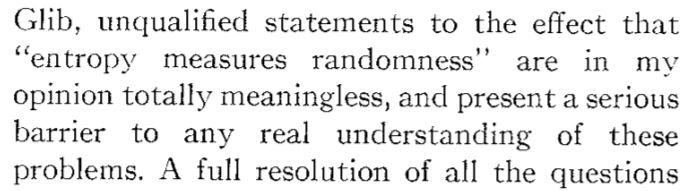
Gibbs vs Boltzmann Entropies
*
*
*
*
*
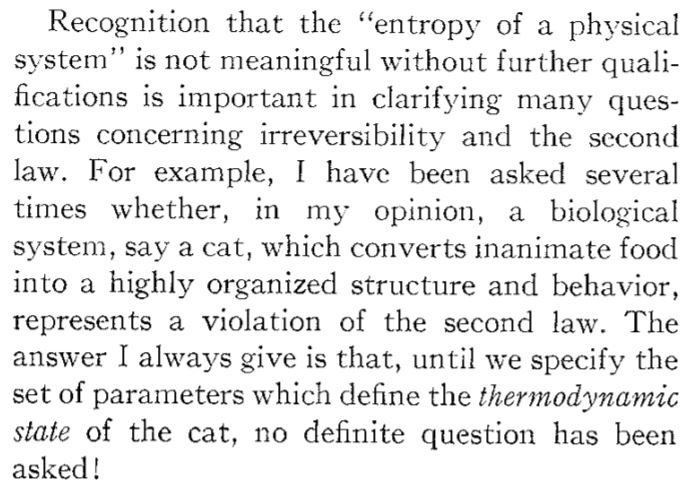
Important observation: Entropy is a characteristic of a thermodynamic system, not of a physical system. Because a physical system admits of many thermodynamic systems. The thermodynamic state is defined via a set of parameters (or degrees of freedom).
Paper here
Proportio: Cusanus: Proportionabilia; Erigena: Comportionabilis; Vitruvius: Commodulatio
 Nicolas of Cusa offers an interesting argument which related number, proportion, substance, and accident:
and the term pro-portion-abilia reveals its origin as a portion.Omnis igitur inquisitio in comparativa proportione facili vel difficili existit; propter quod infinitum ut infinitum, cum omnem proportionem aufugiat, ignotum est. Proportio vero cum convenientiam in aliquo uno simul et alteritatem (otherness) dicat, absque numero intelligi nequit. Numerus ergo omnia proportionabilia includit. Non est igitur numerus in quantitate tantum, qui proportionem efficit, sed in omnibus, quae quovismodo substantialiter aut accidentaliter convenire possunt ac differre. (De Docta Ignorantia, iii).
And Scotus Erigena uses (coins?) another related term: comportionabilis (comportionalis) but related to equality whereas proportionabilis is related to number.
Ut autem decurramus per media ad extrema, rursus dicand finally Vitruvius, the authority in symmetry explains the origin of proportione:
imus, quodneque numerus est, quia non est ad paria (part) vel in paria proportionabilis,
nec magnitudo, quia non est augmentabilis,
nec parvitas, quia non est minorabilis,
nec aequalitas, quia non est comportionabilis,
nec similitudo, quia nulli rei comparabilis,
nec dissimilitudo, quia a nullo est discrepabilis,
nec stat, quia non est res immobilis,
nec movetur, quia non est volubilis,
nec silentium agit, quia non est verbo mentali vel vocali reprehensibilis. (Expositiones in Mysticam theologiam S. Dionysii, PL (auctor 810-877))
Aedium compositio constat ex symmetria, cuius rationem diligentissime architecti tenere debent. Ea autem paritur a proportione, quae graece αναλογια dicitur. Proportio est ratae partis membrorum in omni opere totiusque commodulatio, ex qua ratio efficitur symmetriarum. Namque non potest aedis ulla sine symmetria atque proportione rationem habere compositionis, nisi uti hominis bene figurati membrorum habuerit exactam rationem. (De Architectura 3.1.1.3, 3.1.1.6, 3.1.2.13)
Adaequatio intellectus et rei
Adaequatio intellectus et rei: adequation of the intellect to things (correspondence). Or to paraphrase Hermann Lotze (Logica #130, p. 156), "thought follows reality". A frequent assumption (and fallacy) in science.
Schoolmen
The idea was expressed by William of Auvergne (1190-1249) as
- adaequatio intellectus ad rem (adequation of the intellect to things).
Other versions of the apothegm are:
- veritas est quod est, enuntiativus est natura veritatis et essentiae ejus (Isaac Israeli 823-932),
- veritas est dispositio in re exteriore cum est ei aequalitas (Avicenna),
- adequatio intellectus et rei (Aquinas following Israeli),
- adequatio rei cum intellectu (Albertus Magnus).
- veritas transcendentalis significat entitatem rei, connotando cognitionem seu conceptum intellectus, cui talis entitas conformatur vel in quo talis res representatur (Suarez)
- Ordo et connexio idearum idem est ac ordo et connexio rerum (Spinoza)
Some wording of the schoolmen associated with this concept are:

- conformitas, correspondentia, convenientia, adaequatio, representatio.
Moderns
- Veritas auterm enunciationis seu iudicii nihil aliud est quam conformitas ore factae aut iudicii mente peracto cum ipsa enuntiata seu iudicata (Gassendi)
- ‘truth’, in the strict sense, refers to the conformity of a thought with its object (Descartes, Letter to Mersenne, 16.x.1639)
- Idea vera debet convenire cum suo ideato (Spinoza)
- Let us be content with looking for truth in the correspondence between the propositions that are in the mind and the things they are about. (Leibniz New Essays, IV, v, 11)
- Leibniz wrote: "Dialogus de Connexione inter res et verba, et veritatis realitate" in 1677
20th Century
Ortega y Gasset in Historia como Sistema argues that:- "the world of reality and the world of thought are each a cosmos corresponding one to the other, each compact and continuous, wherein nothing is abrupt, isolated or inaccessible ...Western man believes, then, that the world possesses a rational structure, that is to say, that reality possesses an organization coincident with the organization of the human intellect, taking this, of course, in its purest form, that of mathematical reason.” - "En los últimos años del siglo XVI y ... primeros del XVII ... cree, pues, el hombre de Occidente que el mundo posee una estructura racional, es decir, que la realidad tiene una organización coincidente con la del intelecto humano, se entiende, con aquella forma del humano intelecto que es le más pura: con la razón matemática."
There's now the issue of whether the human intellect is really capable of grasping the infinite complexity of reality. John Duns Scoto phrases this as an objection:
Atqui impossibilis omnino est talis adaequatio et commesuratio inter potentiam finitam et et obiectum infinitum. Ergo, pariter impossibile est infinitum ab intellecto finiti comprehendi.And White
...the finite mind is inadequate to grasp the infinite. SC108And Cusanus
Quoniam ex se manifestum est infiniti ad finitum proportionem non esse (De Docta Ignorantia, Cap iii)and Trithemius also echoes this argument, having resort to an interesting term "incircumscriptibilem":
Deum igitur nobis credere potius quae scire vel intelligere omnino necessarium fuit: propterea que penitus impossibile sit illam super divinam & incircumscriptibilem maiestatem comprehendi a nobis qui nihil intelligimus sine ministerio sensuum & discursu rationis. (Liber octo quaestionum ad Maximilianum Caesarem de fide et intellectu)and Lactantius:
incogitabiles... inextricabiles...inaestimabilem potestatem. Dubitet vero aliquis, an quidquam difficile aut impossibile sit Deo, qui tanta tamque mirifica opera providentia excogitavit, virtute constituit, ratione perfecit; nunc autem spiritu sustentet, potestate moderetur, inexcogitabilis, ineffabilis, et nulli alii satis notus quam sibi? (Divinarum Inst., lib i)But Arthur Eddington introduces a radically different account:
We have learnt that the exploration of the external world by the methods of physical science leads not to concrete reality, but to a world of symbols.Along the same lines James Jeans suggests,
The essential fact is simply that all the pictures which science now draws of nature, and which alone seem capable of according with observational fact, are mathematical pictures...They are nothing more than pictures – fictions if you like, if by fiction you mean that science is not yet in contact with ultimate reality.”
Futuritionis
Futuritionis is a latin term which was related to the concept of probability and also of potentiality. Was it related to the future prediction of something?
The full spectrum of terms is: pastness (praeteritionis), presentness (praesentalitatis), and futurity (futuritionis).
Certitudo rei cujusvis spectatur vel objective & in se; nec aliud significat, quam ipsam veritatem existentiae aut futuritionis illius rei: vel subjective & in ordine ad nos; & consistit in mensura cognitionis nostræ circa hanc veritatem. . . . Probabilitas enim est gradus certitudinis, & ab hac differt ut pars a toto.
From the DMLBS (http://logeion.uchicago.edu) qua contingenter
Jacob Bernoulli. The Art of Conjecturing, together with Letter to a Friend on Sets in Court Tennis. Johns Hopkins University Press, Baltimore, 2006. Translation of [22] and commentary by Edith Sylla. 9, 99, 100
The full spectrum of terms is: pastness (praeteritionis), presentness (praesentalitatis), and futurity (futuritionis).
1. Mathematical Meaning
Here's some texts (J. Bernoulli Ars Conjectandi):Certitudo rei cujusvis spectatur vel objective & in se; nec aliud significat, quam ipsam veritatem existentiae aut futuritionis illius rei: vel subjective & in ordine ad nos; & consistit in mensura cognitionis nostræ circa hanc veritatem. . . . Probabilitas enim est gradus certitudinis, & ab hac differt ut pars a toto.
Translation Sylla p. 315Translation mine:
The certainty of anything is considered either objectively and in itself or subjectively and in relation to us. Objectively, certainty means nothing else than the truth of the present or future existence of the thing. Subjectively, certainty is the measure of our knowledge concerning this truth. . . . Probability, indeed, is degree of certainty, and differs from the latter as a part from the whole.
The certitude of things obtains either as objective, i.e. essentially, meaning nothing but the reality of the thing's existence or futurity, or subjective, i.e. arranged to us, consisting in the extent of our knowledge about that reality.
Everything under the Sun that is or has been, past, present, or future, in itself and objectively, always has total certitude. It is apparent what is present and past, for in their very existing or having existed, cannot be otherwise. Nor should be argued of future things.
From the DMLBS (http://logeion.uchicago.edu) qua contingenter
- hic quidem intellectus propheticus est cujus speculum est semper eterna intueri et ab ipso perfici, in quo etsi omnia presentialiter sciebantur, tamen ea que hic preterita sunt aut futura ibi sine preteritione aut futuritione in preteritione et futuritione sua dinoscuntur Ps.-Gros. Gram. 15;
- causa vero in actu est quod presencialiter causat rem, causa in potentia que de futuro potest causare, unde actus hic est presencialitas, et potencia sonat in futuritionem Bacon II 129;
- ‘quando’ respicit partes temporis signatas, sc. preteritionem et futuritionem Ib. VIII 264; ex dictis patet quomodo solvi debeat ad argumenta ad aliam partem: bene enim probant quod futuracio rei non est causa sciencie Dei; sed ex hoc non sequitur quin concurrat ad hoc quod in sciencia Dei sit relacio racionis per quam habet racionem presciencie Middleton Sent. I 338; c1301 an futurum contingens possit certitudinaliter cognosci alia cognicione quam beatifica. ‥ primo cognicione naturali, quia certitudinem illius cognicionis non impedit futuritio nec contingencia Quaest. Ox. 299;
- si voluntas divina esset causa futuritionis omnium futurorum, esset causa veritatis omnium proposicionum verarum, eciam contingencium de futuro Bradw. CD 212C;
- ad secundum dicitur quod assumptum est impossibile. cum non sit possibile Deum preordinasse produccionem prime creature, nisi per instans primum cujus est, futuritio non fuit, nec potencia ante actum ‥; quamvis forte futuritio mundi sicud et cujuscumque alterius rei sit eterna a parte ante, nec alia est futuritio, cum res fuerit et alia antequam fuerit, et sic futuritio prime creature est eterna Wycl. Log. III 226;
- sic aliqua sunt et necessario existunt, ut Trinitas increata, aliqua sunt et necessario non existunt ut pretericiones, futuritiones, possibilitates Id. Ver. II 128;
- 1412 sicut Deus necessitat futuracionem parcium, sic necessitat ad omnes eventus , qui in illis partibus sunt futuri Conc. III 349;
- futuritio ergo rei est verum objectum presciencie ut presciencia est Netter DAF I 81a.
2. Theological Meaning
For one thing, the locution Futurition is almost always found in theological treatises. One instance of such discussion is afforded by a lengthy philosophical consideration by Richard Baxter (1615-1691) in An ANSWER TO Mr. Polehill's Exceptions about Futurition.
In Reformed circles: Leidecker, Burman,
Another example is the Franciscan Bonaventura: ratione futuritionis. (Sent., Bk. I, d. 41, a. 2, q. 1, 4 arg. ad opp.).
Or Aquinas ratio futuritionis futurorum.
Or Tomasz Młodzianowski (1666)
Si autem nulla futura fuissent futura, processisset verbum ex cognitione non futurae futuritionis futurorum.
Or Aquinas ratio futuritionis futurorum.
Or Tomasz Młodzianowski (1666)
Si autem nulla futura fuissent futura, processisset verbum ex cognitione non futurae futuritionis futurorum.
3. Philosophical Meaning
Kant following Leibniz said:
The events which occur in the world have been determined with such certainty, that divine foreknowledge, which is incapable of being mistaken, apprehends both their futurition (futuritio) and the impossibility of their opposite. New Elucidation 1:400.
References:
Jacob Bernoulli. The Art of Conjecturing, together with Letter to a Friend on Sets in Court Tennis. Johns Hopkins University Press, Baltimore, 2006. Translation of [22] and commentary by Edith Sylla. 9, 99, 100
Presumption and Probability in Talmud
Hazakah indicates presumption and sometimes coincides with rabbah, or rubba, or rov which is the rule of the majority, or a type of frequentist probability.
There's an 11 volume work on hazakah by R. Jacob L. Kroch.
References:
Kroch, Jacob Leib ben Shemaiah. Encyclopaedia Judaica. . Encyclopedia.com. (February 19, 2017).
J.L. Kroch, Hazakah Rabbah, 1 (1927), introduction by P.J. Kohn; J.L. Kroch, Halakhah Rabbah, 2 (1966), introduction by A. Krauss.
There's an 11 volume work on hazakah by R. Jacob L. Kroch.
References:
Kroch, Jacob Leib ben Shemaiah. Encyclopaedia Judaica. . Encyclopedia.com. (February 19, 2017).
J.L. Kroch, Hazakah Rabbah, 1 (1927), introduction by P.J. Kohn; J.L. Kroch, Halakhah Rabbah, 2 (1966), introduction by A. Krauss.
Majority, Multitude, and Probability in Biblical and Talmudic writers
R. Louis Jacobs observes that:
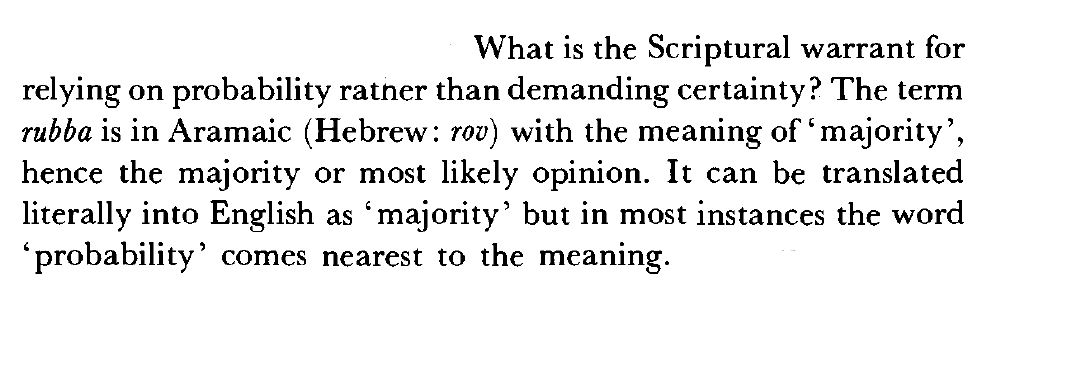
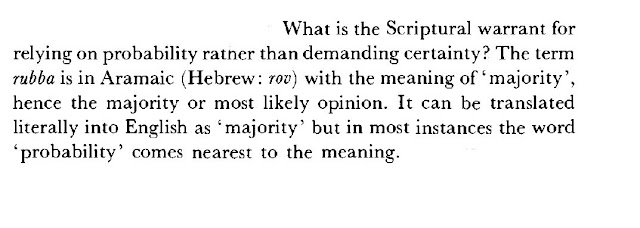 Thus probability in Hebrew is rab (רָב, abundance). It seems an interesting vindication of the frequentist version of probability! But specifically, it reinforces the intuitive idea that probability are statements about aggregates.
Interestingly enough, there is the the Justinian Digest a rule of thumb to overcome evidential deadlocks enunciated by Paulus that hinges on the concept of the majority (plerumque):
Reference
Jacobs, L. (1984) The Talmudic Argument. Cambridge UP, p. 50f.
Interestingly enough, there is the the Justinian Digest a rule of thumb to overcome evidential deadlocks enunciated by Paulus that hinges on the concept of the majority (plerumque):
In obscuris, inspici solere quod, verisimilius est, aut quod plerumque fieri solet. Corpus Iuris Civilis, Justinian Digest 50.17.114.
(when there is obscurity, we usually regard that what has appearance of truth or what is mostly done)
Reference
Jacobs, L. (1984) The Talmudic Argument. Cambridge UP, p. 50f.
De ars ignorandi
 Sebastian Castellio included curious but challenging aspects in the title to his treatise: De Arte dubitandi & confidendi, ignorandi, & sciendi published in Basel in 1563. I call attention to:
ars ignorandi: 'De ignorando hoc dico: ignorare nobis ea licet, quae homini non sunt ad salutem necessaria, quae multa esse nemo sapiens negabit' (p.50) and also 'Ignorare autem ea licet, quae nec a Deo praecepta, nec homini ad Deum cognoscendum officumve suum discendum aut faciendum iusticiaque fungendum, sun necessaria' (p.51).
Of course, these observations remind one of 1 Cor 2:2: Non enim judicavi me scire aliquid inter vos, nisi Jesum Christum, et hunc crucifixum.
References
- Castellion, S. (1981). De arte dubitandi et confidendi, ignorandi et sciendi. Brill.
- Castellion, S. (1953). De l'art de douter et de croire, d'ignorer et de savoir. Traduit de l'original Latin par Charles Baudouin. Genéve, Jeheber.
- Calvetti, C. G. (2005). Il testamento dottrinale di Sebastiano Castellion e l'evoluzione razionalistica del suo pensiero. Vita e Pensiero.
- For the disquisitions of Castellion on hazard, or chance, see Bru, B. (2006) The Bernoulli Code. J. Electronique d'Histoire des Probabilites et de la Statistique. 2, 1. Here
Relationship between the Poisson Process and the Gumbel Distribution
For a given sequence or collective, if:
- the interarrival times between events are well described by an exponential distribution
- the probability of ocurrence of events at any given year are described by a Poisson distribution
- and the duration of events is described by a Gamma distribution
then the sequence has been generated by a Poisson stochastic process.
And, E. Gumbel showed that the distribution of maximum values taken from samples of an exponential distribution, converges to the Gumbel distribution. Therefore, the events' maximum interarrival times generated by a Poisson process, are Gumbel distributed.

The Inductive grounding of Deductive Systems!
The Stanford Encyclopedia of Philosophy says that: "Reichenbach does not argue that induction is a sound method; his account is rather ...[a] vindication: that if any rule will lead to positing the correct probability, the inductive rule will do this, and it is, furthermore, the simplest rule that is successful in this sense."
The conclusions of inductions are not asserted, they are posited. “A posit is a statement with which we deal as true, though the truth value is unknown” (TOP, 373)
The flow of reasoning seems to be similar to Von Mises, and Mach, i.e. a Kantian, in that first observe nature empirically and from there derive mathematical concepts and axioms. In this way, even axioms are derived by induction and then, perhaps, generalizable by deduction.
Moreover, Moritz Schlick arrived to a similar conclusion, in that the
which is a very bold assertion to make! Induction is at the base of Deduction, where the latter is customarily considered to be superior to the former!
 |
| J. Alberto Coffa circa 1973 from here |
The flow of reasoning seems to be similar to Von Mises, and Mach, i.e. a Kantian, in that first observe nature empirically and from there derive mathematical concepts and axioms. In this way, even axioms are derived by induction and then, perhaps, generalizable by deduction.
Moreover, Moritz Schlick arrived to a similar conclusion, in that the
"...the construction of a strict deductive science has only the significance of a game with symbols." GTK, 37 in Coffa, 176.Russell, against Poincare, held the same view:
Geometric indefinables [i.e. components of axioms] are first given to us in acquaintance [i.e. intuition]. Coffa, 132And also
Russell explained that the reasons we have for accepting a fomula as a truth of logic are "inductive". Coffa 124
which is a very bold assertion to make! Induction is at the base of Deduction, where the latter is customarily considered to be superior to the former!
Propositional attitudes
The proposition attitude, posited Russell, is our disposition towards the judgment's content. They include understanding, assuming, wondering, asserting, believing, desiring, imagining, feeling, affirming... See Coffa, 67.
Can the propositional attitudes be "aggregated"? See here
Can the propositional attitudes be "aggregated"? See here
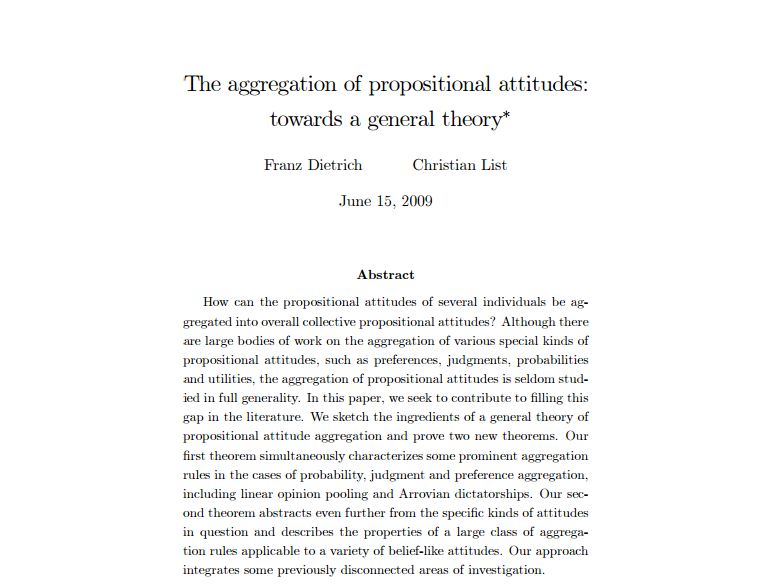 |
| Diestrich and List (2010): Oxford Studies in Epistemology 3: 215-234, 2010 |
Meaning and origin of the Ceteris Paribus term
Maybe Aristotle was the first to state it:
ἔστω γὰρ αὕτη ἡ ἀπόδειξις βελτίων τῶν ἄλλων τῶν αὐτῶν ὑπαρχόντων, ἡ ἐξ ἐλαττόνων αἰτημάτων ἢ ὑποθέσεων ἢ προτάσεων...: We may assume the superiority ceteris paribus (other circumstances being similar) of the demonstration which derives from fewer postulates or hypotheses — in short from fewer premisses; for, given that all these are equally well known, where they are fewer knowledge will be more speedily acquired, and that is a desideratum. Posterior Analytics, I, 25.
Some say that the term was coined by Cicero:
Cicero (44BC) De Officiis I, xv: si cetera paria sunt: if other matters are equal.
Cicero (44BC) De Officiis I, xxiii: Quid si haec paria in utroque?: What if these are equal in both?
Seneca, De Beneficis (62), IV, 35, 3: Omnia esse debent eadem, quae fuerunt (rebus sic stantibus)
Nicolai de Oresme, Quaestiones Animam II, 17: quia cetera non sunt paria:
Nicolai de Oresme, Quaestiones Physicam 7, 10: ceteris omnibus paris:
Bernardino Telesio, De rerum natura, Pro., ...naturam... quae summe sibi ipsi concors idem semper et eodem agit modo atque idem semper operatur.
Ulloa, J. (1711) Prodromus, caetera non sunt paria (266); concede si caetera sint paria, nega si disparia (166) ...quando caetera fuerint paria, neganda vero quando fuerint imparia (424).
George Campbell (1776), Phil Rhet, 76: "This is the ordinary course of nature." "Such an event may reasonable be expected, when all the attendant circumstances be similar."
Lainez, J. (1886) Disputationes, v.2, II, I,, 2. p.229: si caetera paria sint.
An interesting definition by G. Reed Thesaurus, (1891) p.35 : Quando in una re a similitudine argumentamur ad aliam; v.g. sicut se habet genus ad speciem; sic se habet materia ad compositum; ergo sicut genus in recto praedicatur de specie, etiam materia praedicabitur de composito. Resp. negando consequen. quia cetera non sunt paria: disparitas est in hoc, quia genus est totum potentiale, et ut totum significatur, materia vero semper est pars. Et huc venit illud; «est par, vel est dispar ratio »; nam ubi cetera non sunt paria, debet disparitas, aut dispar ratio assignari. Also, ceteris vel omnibus paribus.
One of the most authoritative statements comes from Jakob Bernoulli who was the pioneer of Probability:
Jakob Bernoulli, Ars Conjectandi, 224: in simili rerum statu (in a similar state of affairs [of things]) clearly denoting a systems view. The complete quotation is very clear: Quandoquidem praesumi debet, tot casibus unumquodque posthac contingere et non contingere posse, quoties id antehac in simili rerum statu contigisse et non contigisse fuerit deprehensum. (For it should be presumed that each event will occur or not occur in the future as many times as it has been observed, in a similar state of affairs, to have occurred or not occurred in the past.) From Adams, W. (1974) The Life and Times of the CLT, 10.
ἔστω γὰρ αὕτη ἡ ἀπόδειξις βελτίων τῶν ἄλλων τῶν αὐτῶν ὑπαρχόντων, ἡ ἐξ ἐλαττόνων αἰτημάτων ἢ ὑποθέσεων ἢ προτάσεων...: We may assume the superiority ceteris paribus (other circumstances being similar) of the demonstration which derives from fewer postulates or hypotheses — in short from fewer premisses; for, given that all these are equally well known, where they are fewer knowledge will be more speedily acquired, and that is a desideratum. Posterior Analytics, I, 25.
Some say that the term was coined by Cicero:
Cicero (44BC) De Officiis I, xv: si cetera paria sunt: if other matters are equal.
Cicero (44BC) De Officiis I, xxiii: Quid si haec paria in utroque?: What if these are equal in both?
Seneca, De Beneficis (62), IV, 35, 3: Omnia esse debent eadem, quae fuerunt (rebus sic stantibus)
Nicolai de Oresme, Quaestiones Animam II, 17: quia cetera non sunt paria:
Nicolai de Oresme, Quaestiones Physicam 7, 10: ceteris omnibus paris:
Bernardino Telesio, De rerum natura, Pro., ...naturam... quae summe sibi ipsi concors idem semper et eodem agit modo atque idem semper operatur.
Ulloa, J. (1711) Prodromus, caetera non sunt paria (266); concede si caetera sint paria, nega si disparia (166) ...quando caetera fuerint paria, neganda vero quando fuerint imparia (424).
George Campbell (1776), Phil Rhet, 76: "This is the ordinary course of nature." "Such an event may reasonable be expected, when all the attendant circumstances be similar."
An interesting definition by G. Reed Thesaurus, (1891) p.35 : Quando in una re a similitudine argumentamur ad aliam; v.g. sicut se habet genus ad speciem; sic se habet materia ad compositum; ergo sicut genus in recto praedicatur de specie, etiam materia praedicabitur de composito. Resp. negando consequen. quia cetera non sunt paria: disparitas est in hoc, quia genus est totum potentiale, et ut totum significatur, materia vero semper est pars. Et huc venit illud; «est par, vel est dispar ratio »; nam ubi cetera non sunt paria, debet disparitas, aut dispar ratio assignari. Also, ceteris vel omnibus paribus.
One of the most authoritative statements comes from Jakob Bernoulli who was the pioneer of Probability:
Jakob Bernoulli, Ars Conjectandi, 224: in simili rerum statu (in a similar state of affairs [of things]) clearly denoting a systems view. The complete quotation is very clear: Quandoquidem praesumi debet, tot casibus unumquodque posthac contingere et non contingere posse, quoties id antehac in simili rerum statu contigisse et non contigisse fuerit deprehensum. (For it should be presumed that each event will occur or not occur in the future as many times as it has been observed, in a similar state of affairs, to have occurred or not occurred in the past.) From Adams, W. (1974) The Life and Times of the CLT, 10.
But there is one other interesting version:
- caeteris manentibus.


On the Reference Class Problem
Extremely important conceptualization of the key problem of many fields of inquiry... expand
Reichenbach defines it:
In any case, Here's an interesting example of a taxonomy that somehow falls within a reference class problem:
Another interesting classification:
See also the definition of Collingwood of universal and reference classes in Speculum Mentis, 162-163.
Cicero in the Orator (4.16) says:
See also
Reichenbach defines it:
“If we are asked to find the probability holding for an individual future event, we must first incorporate the case in a suitable reference class. An individual thing or event may be incorporated in many reference classes, from which different probabilities will result. This ambiguity has been called the problem of the reference class”. In Reichenbach, H. (1949): The Theory of Probability, California U.P., 374.Moreover, Reichenbach has more to say on how the reference class is arrived at:
Of course, reliable statistics implies a detailed knowledge of causes, etc. Now, the classical definition by Venn is:If probability belongs to a class, its numerical value is determined because for a class of events a frequency of occurrence may be determined. A single event, however, belongs to many classes; which of the classes are we to choose as determining the weight? Suppose a man forty years old has tuberculosis; we want to know the probability of his death. Shall we consider for that purpose the frequency of death within the class of men forty years old, or within the class of tubercular people? And there are, of course, many other classes to which the man belongs. The answer is, I think, obvious. We take the narrowest class for which we have reliable statistics.
every single thing or event has an indefinite number of properties or attributes observable in it, and might therefore be considered as belonging to an indefinite number of different classes of things", leading to problems with how to assign probabilities to a single case. He used as an example the probability that John Smith, a consumptive Englishman aged fifty, will live to sixty-oneDurkheim (The Rules of Sociological Method, Free Press, 1982, H. Walls trans., p. 110), in proposing methods of sociological research, analyzes the implicit difficulties of finding clear-cut definitions of species and genera and provides useful insights into them:
...It is untrue that science can formulate laws only after having reviewed all the facts they express, or arrive at categories only after having described, in their totality, the individuals that they include. The true experimental method tends rather to substitute for common facts, which only give rise to proofs when they are very numerous and which consequently allow conclusions which are always suspect. decisive or crucial facts. as Bacon said which by themselves and regardless of their number, have scientific value and interest. It is particularly necessary to proceed in this fashion when one sets about constituting genera and species. This is because to attempt an inventory of all the characteristics peculiar to an individual, is an insoluble problem. Every individual is an infinity, and infinity cannot be exhausted. Should we therefore stick to the most essential properties? If so, on what principle will we then make a selection? For this a criterion is required which is beyond the capacity of the individual and which consequently even the best monographs could not provide. Without carrying matters to this extreme of rigour, we can envisage that, the more numerous the characteristics to serve as the basis for a classification, the more difficult it will also be, in view of the different ways in which these characteristics combine together in particular cases, to present similarities and distinctions which are clear-cut enough to allow the constitution of definite groups and sub-groups.
Even were a classification possible using this method, it would present a major drawback in that it would not have the usefulness it should possess. Its main purpose should be to expedite the scientific task by substituting for an indefinite multiplicity of individuals a limited number of types. But this advantage is lost if these types can only be constituted after all individuals have been investigated and analysed in their entirety. It can hardly facilitate the research if it does no more than summarise research already carried out. It will only be really useful if it allows us to classify characteristics other than those which serve as a basis for it, and if it furnishes us with a framework for future facts. Its role is to supply us with reference points to which we can add observations other than those which these reference points have already provided. But for this the classification must be made, not on the basis of a complete inventory of all individual characteristics, but according to a small number of them, carefully selected. Under these conditions it will not only serve to reduce to some order knowledge already discovered, but also to produce more. It will spare the observer from following up many lines of enquiry because it will serve as a guide. Thus once a classification has been established according to this principle, in order to know whether a fact is general throughout a particular species, it will be unnecessary to have observed all societies belonging to this species - the study of a few will suffice. In many cases even one observation well conducted will be enough, just as often an experiment efficiently carried out is sufficient to establish a law.The value of Durkheim's observation lies more on the enunciation of the difficulties of the reference class problem, rather than in the solution that he proposed, which seems to open many other difficulties.
In any case, Here's an interesting example of a taxonomy that somehow falls within a reference class problem:
 |
| Variation in size of different types of soil. From Kay (1990) |
Another interesting classification:
 |
| Scale definitions and different processes with characteristic and horizontal scales. (Isidoro Orlanski, BAMS, 05/1975, 56, 5, 528) |
Cicero in the Orator (4.16) says:
Nor, indeed, without having studied in the schools of philosophers, can we discern the genus (classes) and species of everything; nor explain them by proper definitions; nor distribute them into their proper divisions; nor decide what is true and what is false; nor discern consequences, perceive inconsistencies, and distinguish what is doubtful.See also, Keynes discussion of the concept in A Treatise on Probability (1948 Macmillan) p. 103ff.
See also
- J. Alberto Coffa (1974), Hempel’s Ambiguity. Synthese 28, 141-163
- See Stern, R. (2012) Individual Risk, The Journal of Clinical Hypertension, Volume 14, Issue 4, 261 - 264
- Kay, B. (1990) Rates of Change of Soil Structure Under Different Cropping Systems. Advances in Soil Science, 12, 1-52
Review of "An Introduction to Generalized Linear Models, 2nd Edition (Chapman & Hall/CRC Texts in Statistical Science)
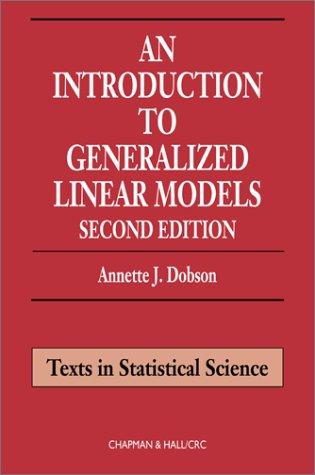 This is a wonderful introductory text to Generalized Linear Models (GLM). The text is crystal clear, concise and practical. There are enough illustrations to explain the concepts. The author does a great job in showing step by step the unity of many statistical techniques that otherwise are often taught unrelated in classrooms. The book helps to visualize the techniques as part of a coherent, interrelated theoretical system. One topic that I didn't find well explained and linked to the whole system is ANOVA in Ch. 6.
Below there are some book exercises solved in Matlab:
Example 4.2: Pressure Vessels. Data is described by a Weibull distribution. Find the parameters of the distribution with the log-likelihood method.
>> data = [1051 1337 1389 1921 1942 2322 3629 4006 4012 4063 4921 5445 5620 5817 5905 5956 6068 6121 6473 7501 7886 8108 8546 8831 9106 9711 9806 10205 10396 10861 11026 11214 11362 11604 11608 11745 11762 11895 12044 13520 13670 14110 14496 15395 16179 17092 17568 17568];
>> [phat,pci] = mle(data,'distribution','wbl','ntrials',4);
>> phat = [9906.04877603439 2.01497978979166]
pci =
8564.07301904226 1.59974255374879
11458.3098643578 2.53799809460243
Example 4.4: Poisson regression example. The proposed function is Poisson, and the link function is identity. Basically, fit a regression line of the form
 and the link function is
>> X = [-1 -1 0 0 0 0 1 1 1];
>> Y = [2 3 6 7 8 9 10 12 15];
>> [B DEV] = glmfit(X,Y,'poisson','link','identity');
>> B = [7.45163328911152 4.93530039799631]
DEV = 1.89465033525567
Interestingly the deviance of a gamma function is 0.25. Therefore Gamma might be a better model.
Example 7.2:
Fit a GLM to binomial data p. 119. The solution in Matlab is:
 data:
data: 1.6907 59.0000 6.0000
1.7242 60.0000 13.0000
1.7552 62.0000 18.0000
1.7842 56.0000 28.0000
1.8113 63.0000 52.0000
1.8369 59.0000 53.0000
1.8610 62.0000 61.0000
1.8839 60.0000 60.0000
col1 = Dose (xi), col2 = #of bettles (ni), col3 = #beetles killed (yi). So
>> b = glmfit(xi,[yi ni],'binomial','link','logit');
b =
-60.7175
34.2703
>> xfit = glmval(b,D(:,1),'logit');
>> plot(D(:,1),xfit,'r')
Using another link functions, Replacing logit by 'probit', or 'comploglog', the best is cpmploglog, i.e. extreme value. The deviance has to be less than X2(N-p) = X2(8-2). In Matlab is
>> chi2inv(0.95,6) = 12.59. The Extreme Valur deviance is 3.44 as opposed to 11.23 of the logit.
>> chi2inv(0.95,6) = 12.59. The Extreme Valur deviance is 3.44 as opposed to 11.23 of the logit.
Subscribe to:
Posts (Atom)