Showing posts with label Toulmin. Show all posts

On Modal Qualifiers

While Aristotle's enthymemes have conclusions that follow necessarily the premises, Toulmin's contributed the modal qualifiersA modal qualifier might turn some sort of fallacies into valid arguments. That's why they're so important.  But that's not it. Aristotle leaves little margin for arguments less than perfect, or premises that carry some uncertainty whereas modal qualifiers weight the quality of the assertion. So what are the "modal qualifiers"? (please refer to my previous post on Toulmin's model below):
"The modal qualifier specifies the degree of certainty, the force of the assertion, the terms and conditions that limit it (the assertion). It is the concession granted to others....the certainty with which the arguments are held varies in degree and force, that is why conclusions are held probable, possible or presumable. The function of a modal qualifier is to establish the likelihood...They reveal the strength of the thesis...establishes the certainty of the author regarding the generality of his assertion."  (Rodríguez Bello, 2004)
The same author goes on to establish how the modal qualifiers work, namely:

1) Adverb that modify the verb
2) Adjective that modify the substantive
3) The mood of the verb

Some examples include: "maybe, surely, typically, usually, some, few, sometimes, most, perhaps", plausibly.

In a fascinating paper, Inglis et al. (2007), explore the mathematical argumentation of some talented mathematicians, applying the Toulmin model, and specifically the use of modal qualifiers. They argue that: there are at least 3 warrant types. The first two of the listed below reduce the uncertainty of the initial assertions while the last one, actually removes the uncertainty.

1)  Inductive Warrant

Here a person works few examples of a particular problem to ascertain the degree of truth assigned to a conjecture. In other words, "a 'crucial experiment' [is worked]... to persuade himself of a statement's probable truth". This approach departs from the particular and makes assertions about the general, i.e. induction. However, it must ineluctably be accompanied/moderated by a modal qualifier since it's not possible to reach  a perfect certainty with this type of reasoning. The strength of this warrant is in reducing the uncertainty and clearing the way to keep on a particular argumentative track.

2) Structural-Intuitive Warrant

This warrant relies in the mental structure to provide intuitive insights into a problem. It shares a portion of induction, and therefore, must accompanied also by modal qualifiers. Consequently, this warrant also aims at reducing and not exhaustively proving an assertion. It "...acts to reduce the uncertainty sufficiently to continue the argument in the given direction".

3) Deductive Warrant

This proof scheme departs from axioms, or solid ground, to attain truth without any rebuttal. Unlike the previous schemes, this one aims at removing uncertainty. The modal qualifiers here express total confidence in the warrant, provided it is flawless.

Thus the use of appropriate modal qualifiers furnish the warrant type with the appropriate degree of certainty that it was intended to have.

References:
  • Rodríguez Bello, L.I. (2004) "El Modelo argumentativo de Toulmin en la escritura de artículos de investigación educativa" [online]. Revista Digital Universitaria. 01/31/2004, <http://www.revista.unam.mx/vol.5/num1/art2/art2.htm> [Retrieved: 02/01/2004].
  • Pinto, R.C. (2007). On understanding ‘probably’ and other modal qualifiers. In H.V. Hansen, et. al. (Eds.), Dissensus and the Search for Common Ground, CD-ROM (pp. 1-10). Windsor, ON: OSSA.
  • Inglis, M., Mejia-Ramos, J.P., Simpson, A., (2007) Modelling mathematical argumentation: the importance of qualification. Educ Stud Math (2007) 66:3–21.

Review of: "An introduction to reasoning"

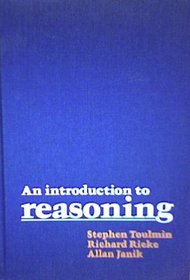
Written by Stephen Toulmin, a renowned British philosopher, R. Rieke, (professor of communication at Utah) and A. Janik (philosopher at Innsbruck), this book proposes an approach to the enthymeme that starts from the conclusion, moves towards the premises and also assigns a degree of uncertainty to the conclusion. This book is not so much to be read, but to be studied. The only way to take advantage of the powerful approach presented is to apply it to concrete situations. The following summary of the entire approach is offered in page 27:
"The claims involved in real-life arguments are accordingly, well founded only if sufficient grounds of an appropriate and relevant kind can be offered in their support. These grounds must be connected to the claim, by reliable, applicable warrants, which are capable in turn of being justified by appeal to sufficient backing of the relevant kind. And the entire structure of argument put together out of these elements must be capable of being recognized as having this or that kind and degree of certainty or probability and as being dependent for its reliability on the absence of certain particular extraordinary, exceptional, or otherwise rebutting circumstances."
Fig. 1: Diagram of the complete argument process
 (from Toulmin et al., 1979)
The approach is therefore presented as (see next figure):
  1. Claims (Conclusion)
  2. Grounds (Premises)
  3. Warrants (Reasoning from Premises to Conclusion)
  4. Backing (demonstrate that the warrant process is sound and relevant)
  5. Modal qualifiers (indicates the reliance of the claims based on quality of grounds and warrant), like probably, presumably, etc.
  6. Rebuttal: exceptions for which the claim cease to hold.
Part II of the book explains all these steps in detail, with too much examples I might say. In page 78, the authors explain the structure of the argument (Fig.1): 
"Given grounds, G, we may appeal to warrant, W (which rests on backing, B), to justify the claim that C—or, at any rate, the presumption (M) that C—in the absence of some specific rebuttal or disqualification( R)." 
My "rule-of-thumb" for the model is:
G, therefore M-C because W, as shown by B, unless R.
Part III of the book is perhaps the most juicy part. It discusses rational merits of arguments, cross-purposes, adversary/consensus procedures, when & how to raise an argument, classification or arguments (analogy, generalization, cause, sign, dilemmas), fallacies all in the context of the scheme in Fig. 1.

Part IV, applies the reasoning scheme to special fields. I didn't find anything really new in the science part.

 An idea
A question that came to my mind is: can we follow a "recipe" to build an argument and still be creative? Nobody will argue that a great deal of creativity is needed to get the right premises or warrants. However, I thought of an approach that might appeal to people not very fond of recipes.
Let's suppose that in an unconscious level our mind deals with arguments in the same way the mentioned pattern, or another similar, does. Let's also consider the possibility that, under some circumstances, the following of a fixed recipe to build an argument might interfere with the creativity involved in the process of connecting the different elements. So let the ideas flow freely. Do a brainstorming free of any constraints of classification or order and get as much ideas as possible to support a claim or join grounds to a claim. Once there isn't any new ideas brought, then the organization must take place. It's precisely at this stage that we take advantage of the system in Fig. 1 and plug these ideas into all of its boxes. This exercise might have a twofold benefit, 1) by organizing the ideas will, for sure, shed new insights of the argument; 2) Creativity is not blocked and can produce freely, even linking to some other problems, etc. Once all ideas are organized and some new insights has been acquired, we might feel that we want to iterate and produce another brainstorming with the newly acquired insights, plug into the pattern and so on, until we arrive at an argument configuration that is acceptable.

My opinion about the book.

The book might have too much examples in the text for some readers like me, mostly in the first part. I guess that some examples might be safely removed without any loss of clarity.
The argument scheme presented is fascinating. It explains and connects concepts that lie scattered in our heads, and organizes them as a system. And a system is a very powerful tool. I have applied the scheme to organize a scientific paper, and it has really helped me a lot. I plan to read the book again.

(to be continued...)