Showing posts with label Metaphors. Show all posts

Iconography of the Scientific Imagination

Interesting title, that hinges on deep characteristics of scientific thinking. The book itself is about a pictorial display in the National Library in Buenos Aires, Argentina.
Authors: Héctor Ciocchini, José E. Burucua & Omar Bagnoli.
Commentaries here:

Arguments convince nobody (except mathematicians, some engineers, and some physicists)

Image result for borgesGeniuses invent their predecessors, said Borges. And he himself, maybe invented an argument out of Emerson, and put it at the base of an important observation: arguments, syllogisms, enthymemes, epicheiremes, convince nobody. Now, this might be the Positivists nightmare (yes, including the Earl of Russell) for, didn't they dogmatize that everything, if it was to be scientifically accepted, had to be proven by logic (whatever version we might choose)? And in that iconoclastic impulse, they threw away Metaphysics and Theology.

Yet, years later, when nobody seriously considers Positivism a feasible Philosophy, and after Godel proved Hilbert and his (unwanted?) disciple Russell to be completely wrong insofar the role that they had envisioned for Logic, Borges posits that arguments convince nobody, but Poetry, Parables, and the like do.

An excerpt of the interview that the philosopher Denis Dutton made to Borges explains the idea:

Dutton: Do you think that it is possible then for a story to represent a philosophical position more effectively than a philosopher can argue for it?

Borges: I have never thought of that, but I suppose you’re right, Sir. I suppose you — yes, yes, I think you’re right. Because as — I don’t know who said that, was it Bernard Shaw? — he said, arguments convince nobody. No, Emerson. He said, arguments convince nobody. And I suppose he was right, even if you think of proofs for the existence of God, for example — no? In that case, if arguments convince nobody, a man may be convinced by parables or fables or what? Or fictions. Those are far more convincing than the syllogism — and they are, I suppose. Well, of course, when I think of something in terms of Jesus Christ. As far as I remember, he never used arguments; he used style, he used certain metaphors. It’s very strange — yes, and he always used very striking sentences. He would not say, I don’t come to bring peace but war — “I do not come to bring peace but a sword.” The Christ, he thought in parables. Well, according to — I think that it was Blake who said that a man should be — I mean, if he is a Christian — should be not only just but he should be intelligent ... he should also be an artist, since Christ had been teaching art through his own way of preaching, because every one of the sentences of Christ, if not every single utterance of Christ, has a literary value, and may be thought of as a metaphor or as a parable.
and in a Conference at Harvard Borges observed:
"Had the poet said so in so many words, he would have been far less effective. Because, as I understand it, anything suggested is far more effective than anything laid down. Perhaps the human mind has a tendency to deny a statement. Remember what Emerson said: arguments convince nobody. They convince nobody because they are presented as arguments"
Postscript:

I believe that right in this observation of Borges, there is the solution to the riddle of argumentation. No doubt that Quintilian said that a good orator should be ultimately be a good man. The good man will craft his arguments to persuade rightly.

Borges asserted in his Guayaquil the power of the person over dialectics
"the power lay in the man, not in the dialectic."
"if one prevailed, it was because he possessed the stronger will, not because of dialectical games. As you see, I have not forgotten my Schopenhauer."
"Words, words, words. Shakespeare, the unparalleled master of words, held them in contempt."
References.

Mualem, S. () Borges and Plato: A Game with Shifting Mirrors.
Borges (2000) This Craft of Verse. Harvard


What's the difference (and use) of Tropes and Schemes?

There are many Figures of Speech. But the challenge is to figure out when, where, and how to use them to convey maximum efficacy to the speech.

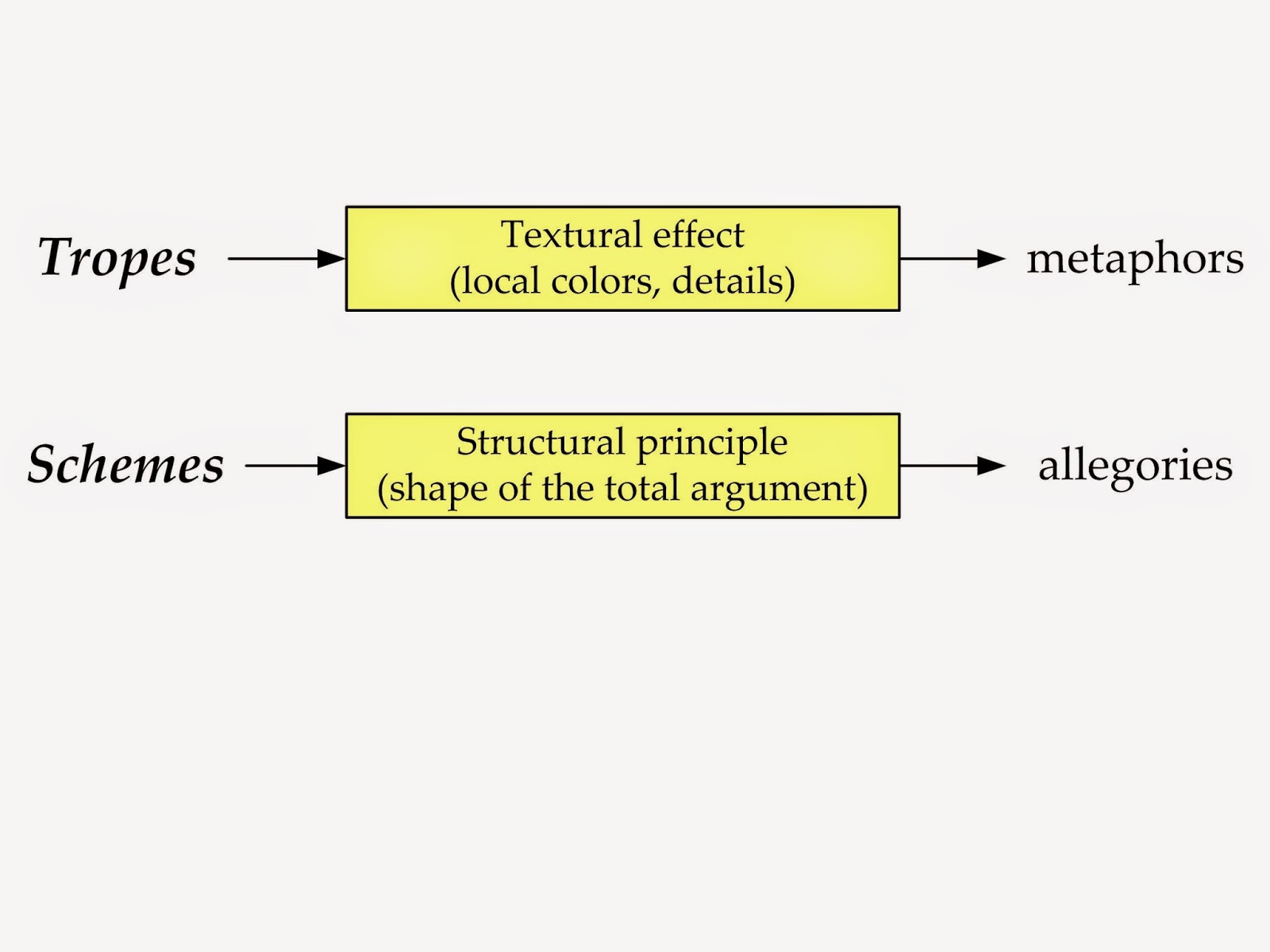
The author of the Rhetoric entry in the Enc. Brit. (5th, Vol. 26, p. 804)  offers a useful functional distinction of tropes and schema:
Ancient rhetoricians made a functional distinction between trope (like metaphor, a textural effect) and scheme (like allegory, a structural principle). To the former category belong such figures as metaphor, simile (a comparison announced by "like" or "as"), personification (attributing human qualities to a nonhuman being or object), irony (a discrepancy between a speaker's literal statement and his attitude or intent), hyperbole (overstatement or exaggeration) or understatement, and metonymy (substituting one word for another which it suggests or to which it is in some way related--as part to whole, sometimes known as synecdoche).
To the latter category (scheme) belonged such figures as allegory, parallelism (constructing sentences or phrases that resemble one another syntactically), antithesis (combining opposites into one statement--"To be or not to be, that is the question"), congeries (an accumulation of statements or phrases that say essentially the same thing), apostrophe (a turning from one's immediate audience to address another, who may be present only in the imagination), enthymeme (a loosely syllogistic form of reasoning in which the speaker assumes that any missing premises will be supplied by the audience), interrogatio (the "rhetorical" question, which is posed for argumentative effect and requires no answer), and gradatio (a progressive advance from one statement to another until a climax is achieved).


Rem tene verba sequentur

  • Cato the Elder: "rem tene, verba sequentur"- when you have the subject, words will follow. (Jordan 80) 
  • Horace: "verbaque provisam rem non invita sequentur" - Once supply the thought, and words will follow as swift as soon as sought. (Horace, Ars 311 in Quintilian Inst. 1.5.2).
  • Dionysius of Halicarnassus: "toutou de aition, oti ou tois onomasi douleuei ta pragmata par' auto, tois de pragmasin akolouthei ta onomata- The reason...is that he does not make his subject the slave of his words, but makes the words conform to the subject. (Lys. 1)
  • Quintilian: "Omnis autem oratio constat aut ex iis quae significantur aut ex iis quae significant, id est rebus et verbis" - Every speech however consists at once of that which is expressed and that which expresses, that is to say of matter and words (Instituto III, v, 1, p. 397)
  • Moreover, "orationem porro omnem constare rebus et verbis: in rebus intuendam inventionem, in verbis elocutionem, in utraque conlocationem, quae memoria complecteretur? actio commendaret." - ... every speech is composed of matter and words, and that as regards matter we must study invention, as regards words, style, and as regards both, arrangement, all of which it is the task of memory to retain and delivery to render attractive. (Inst. viii, Pr.6, 179ff)
  • Quintilian also warns: "For, as a rule, the best words are essentially suggested by the subject matter and are discovered by their own intrinsic light...And if we have to spend all our life in the laborious effort to discover words which will at once be brilliant, appropriate and lucid, and to arrange them with exact precision, we lose all the fruit of our studies" (Institutio, VIII. Pr. 21, 26)
  • There's two key parts in crafting a discourse, inventio (finding the elements of an argument) and dispositio (arrangement). Quintilian explains that: "...sic in dicendo quamlibet abundans rerum copia cumulum tantum habeat atque congestum, nisi illas eadem dispositio in ordinem digestas atque inter se commissas devinxerit" -  ...in speaking, however abundant the matter may be, it will merely form a confused heap unless arrangement be employed to reduce it to order and to give it connexion and firmness of structure. (Institutio, VII, Pr., vol 3. p. 3). 
    • Thus dispositio transforms the confused heap of argumentative loose elements into a persuasive and flowing whole. 
    • REM TENE = inventio, VERBA SEQUENTVR = dispositio
  • "To Ramus, dialectic was the theory of subject matter (i.e. rem) and form in communication, rhetoric the theory of stylistic (i.e. verba) and oral presentation." Howell 165.
  • Parenthesis: Luther said: Res et verba Philippus; verba sine re Erasmus; res sine verbis Lutherus: nec res, nec verba Carolostadius; Table talk DCCCII
  • Crousaz, "It is the thoughts themselves that are the basis of eloquence... It is the manner of thinking that creates beauty of style. It is a gross error to  make it depend either entirely or principally upon the expressions and turns. Whether you would instruct or move, these effects are owing to the things that the words signify, not to the words themselves. Art of Thinking, II 364-365, in Howell, Eighteen Century Logic, 324.
  • Collingwood said: 
    • "Here lies the difference between the desultory and casual thinking of our unscientific consciousness and the orderly and systematic thinking we call science. In unscientific thinking our thoughts are coagulated into knots and tangles; we fish up a thought out of our minds like anchor foul of its own cable, hanging upside-down and draped in seaweed with shellfish sticking to it, and dump the whole thing on deck quite pleased with ourselves for having got it up at all. Thinking scientifically means disentangling all this mess, and reducing a knot of thoughts in which everything sticks together anyhow to a system or series of thoughts in which thinking the thoughts is at the same time thinking the connexions between them. Logicians have paid a great deal of attention to some kinds of connexion between thoughts, but to other kinds not so much." An Essay on Metaphysics, 22
  • As a footnote, Vitruvius tells that symmetry: "is the appropriate agreement [conveniens consensus] of the elements of the work itself, a correspondence [responsus], in any given part, of the separate parts to the entire figure as a whole. Just as in the human body there is a symmetric quality of eurhythmies [symmetros es eurythmiae qualitas] expressed in terms of the cubit, foot, palm, digit, and other small units, so it is in perfect works. (de Architectura, i, ii, 4). "The precepts of symmetries".
  • And to summarize, as Lito Vitale argued when asked about the proper way of playing the piano: si vos no tenés nada que decir, por mas técnica que tengas, es como que estás a medio camino. See interview here (min 12:05).

See Calboli, G. (1995), Quintilian and Horace, Scholia ns 4, 79-100

The structure of analogy through metaphors

A psychologist by the name of Julian Jaynes developed a scheme to understand how the process of analogizing works. It looks to me that Aristotle and others already proposed the same thing some 2000 years before him, in their equation-like reasoning. But Jaynes assigned some labels. Here it goes:


Example: the snow blankets the ground. That is: the snow "lays thoroughly and completely" (metaphrand) upon the ground, much like a blanket (metaphier) covers smoothly (paraphier) a bed. So the act of the snow 'covering' is equated and thus explained by the paraphier.

Diomedes' classification of Tropes

I came across a translation of Diomedes Grammaticus' classification of tropes in P. Robinson, Classical Theories of Allegory and Christian Culture. Duquesne|Harvester Univ. Press, 1981. Diomedes was a 4th century grammarian who wrote a lengthy treatise called Ars Grammatica.
The basic genus is metaphor, and has 11 species:


Classification of Tropes by Quintilian

Here's the classification that Quintilian makes of the Tropes (Institutio VIII, vi). I'll add the definitions later:


What makes a pattern a pattern?

I've been intrigued by the use of analogies, metaphors and schemas in our everyday thinking, in mathematics, in physics, and in engineering. Granted that we resort to all the above all the time in order to build our thoughts. Many philosophers of the modern age already proposed that all thinking, and consequently nature itself, were reducible to a set of few simple notions that upon some algebraic combination could form all of the available knowledge and nature laws. I already wrote about Leibniz and Descartes proposing such views. Today we may feel that those views were unwarranted extrapolations of some cases-where a given field rests upon few notions-into the generality.

However, there cases where the tenet holds! Now, circumscribing ourselves to those cases, I had this question: What makes a pattern a pattern? By pattern I mean that conceptual construct that will be resorted to frequently by us in order to explain, and/or build more elaborate pieces of reasoning.

Geometry is a fertile field for understanding this. A pattern might have these three characteristics:
  1. Regularity: sequences that repeat at constant/regular/predictable intervals of time, space, structure, etc.
  2. Simplicity: must be simple, short. Occam's razor applies here.
  3. Symmetry: the structural coherence upon some axis.
Any figure that doesn't have the above three cannot be a pattern. The most common geometrical figures-line, circle, triangle, square- are patterns. They have layers of pattern-ness: the first is the most obvious, the visual. There's another which is the association of straight lines, and even others as the relationship among figures.

There are more patterns, but that themselves are built upon simpler and more elementary patterns. They are related through laws of association-such as combination, harmonization, equation, parallelization-e.g. the platonic solids.

The Platonic solids:  tetrahedron, cube, octahedron, dodecahedron, icosahedron.

Figure Tetrahedron Cube Octahedron Dodecahedron Icosahedron
Based on: Triangle (3) Square (4) 3 Pentagon (5) 3
Coinciding lines (Assn. rule) 3 3 4 3 5
Faces 4 6 8 12 20

The number of faces is one of the most characteristics. But the other features contribute to the pattern. 

Thus the patterns are the fundamental cognitive categories that the mind resorts to to interpret all type of phenomena. Hence cognition comes to the use of analogies and metaphors to "make sense" of the observed. Therefore, "structuring" is the act of associating proto-patterns, or patterns among themselves to fit an observation.

Metaphors and the Alphabeto Cogitationum Humanarum

In my beautiful copy of the Sartor Resartus, (Henry Altemus, Philadelphia, 1894, p.78) I found this very interesting depiction of Language:

Carlyle
Language is called the Garment of Thought: however, it should rather be, Language is the Flesh-Garment, the Body, of Thought. I said that Imagination wove this Flesh-Garment; and does not she? Metaphors are her stuff: examine Language; what, if you expect some few primitive elements (of natural sound), what is it all but Metaphors, recognized as such, or no longer recognized; still fluid and florid, or now solid-grown and colorless? If those same primitive elements are the osseous fixtures in the Flesh-Garment, Language, — then are Metaphors its muscles and tissues and living integuments
Carlyle contributes this metaphor, that Language is a body whose muscles are metaphors. This caught my attention because of my interest in metaphors, and of language-whose mastery is central to reasoning. This quote reminded me of Leibniz, who thought that it should be possible to find a small set of elementary concepts from which all known and new concepts could be derived; the idea of an alphabet of human thoughts (Alphabeto Cogitationum Humanarum), an irreducible system of notions, that cannot be further clarified. Now, Logic consists in concatenating those simple notions of language into more complex constructions, either inductively (heuristically - ars inveniendi) or deductively (ars demostrandi).  Descartes seems to concur with this idea, because he points that the origin of some of our concepts are basically metaphorically structured: 


I think that there are certain primitive notions in us which are like originals. There are very few such notions. For apart from the most general notions of being, number, duration, ... which apply to everything that we can conceive, we have only the notion of extension that is specifically for the body, and from that flow the notions of shape and movement; and for the soul on its own we have only the concept of thought, which includes perceptions of the understanding and inclinations of the will...

Therefore, the art of combining metaphors, allegories, and other basic notions through logic constitutes the reasoning. It is important therefore that the kids learn a lot of vocabulary, many languages, and read a lot. In doing so, it is how we can foster their reasoning skills. As a last note, Hegel calls the use of "allegories and the like", "the pictorial element in thought" which healthily reminds us about the nature of concept creation, when using these figures.

Check this amazing metaphor resource at: http://metaphors.lib.virginia.edu/

What is abstraction?


Jorge Luis Borges introduces his short story on Ireneo Funes, the Memorious saying that:
To think is to forget differences, to generalize and to abstract.
Borges not only ventured into philosophy (Egginton & Johnson, 2009), but also foretold modern research (Kreiman, 2011; Quian Quiroga, 2012). The above gives a nice summary of what abstraction, and generalization is. I'm interested in defining it, and for that I'm actively collecting all references that come across me. Generalization and abstraction, although related, aren't identical. Both nevertheless are related to the induction problem in that they imply leaps from the particular to the general.
George Berkeley offers a very straightforward explanation of (PHK 7,8)

Abstraction is the singling of object qualities and modes:
...the qualities or modes of things do never really exist ... apart by itself, and separated from all others, but are mixed, as it were, and blended together, several in the same object. But the mind [is] able to consider each quality singly or abstracted from those other qualities with which it is united, [and] does by that means frame to itself abstract ideas. Again, the mind having observed that in the particular extensions perceived by sense there is something common and alike in all, and some other things peculiar, as this or that figure or magnitude, which distinguish them one from another; it considers apart or singles out by itself that which is common... So likewise the mind, by leaving out of the particular ... perceived by sense that which distinguishes them one from another, and retaining that only which is common to all.
 Locke adds:
Since all things that exist are only particulars, how come we by general terms?... Words become general by being made the signs of general ideas. (EUH, IV, iii,6)
Hume elaborates on the relation of ideas:
The very nature and essence of relation is to connect our ideas with each other, and upon the appearance of one, to facilitate the transition to its correlative. The passage betwixt related ideas is, therefore, so smooth and easy... (Treatise 1.4.2.34)
One of the ones I like most  is the one provided by Prof. Paul Humphreys (UVa):
The term ‘abstraction’ has been used in a variety of senses...covered by a process that we can call property elimination, which takes us from whatever total collection of properties (‘Properties’ here includes relations) is possessed by an entity to a proper subcollection of those properties, those properties being left unchanged (Except, of course, for the relation of the remaining properties to the now absent ones). Abstraction thus requires properties to be modular in the sense that the remaining properties are invariant when any given property is eliminated. Extending Ourselves, 141

References

Kreiman, G. (2011) Literary inspiration. Nature, (475), 453.
Quian Quiroga, (2012) Borges and Memory: Encounters with the Human Brain. The MIT Press.
Egginton, W. and Johnson, D. (2009) Thinking with Borges. The Davies Group Publishers.
Locke, Essay on Human Understanding
Berkeley, PHK

"Word choice is guided by analogy"

In a lecture* Douglas Hofstadter gave a very interesting account about how the mind decides which word to choose in a given context to communicate/verbalize an inner concept. He points out that "...word choice is guided by analogy". The "lexical-item choice is always a fight". A fight between many instances, he means. So in order to communicate a particular idea our mind is presented with many word options to choose from. The best word will be chosen by an analogy-evaluation process, i.e. how well a given word matches what is to be expressed. Sometimes a single word "towers above the others" and is good enough to convey what we want to communicate. Some other times there are a bunch of competing words, and choosing from them turns into a mental "fight".
Hofstadter illustrates this fight by showing a histogram in which each word has a "likelihood" of matching the idea. If one words does, then it has the highest value and is chosen. If a couple of words do, then chances are that we by mistake blend them into a single word. This shows the mechanism that operates in our mind.

For further reading see:
  • Hofstadter, D. (2001), Analogy as the Core of Cognition in The Analogical Mind, Gentner, Holyak and Kokinov, Eds. The MIT Press.
  • Hofstadter, D. (2012), The Essence of Thought. Basic Books (to be released September 11, 2012)
_________
* Feb. 6, 2006 Presidential Lecture Stanford (http://www.youtube.com/watch?v=n8m7lFQ3njk)