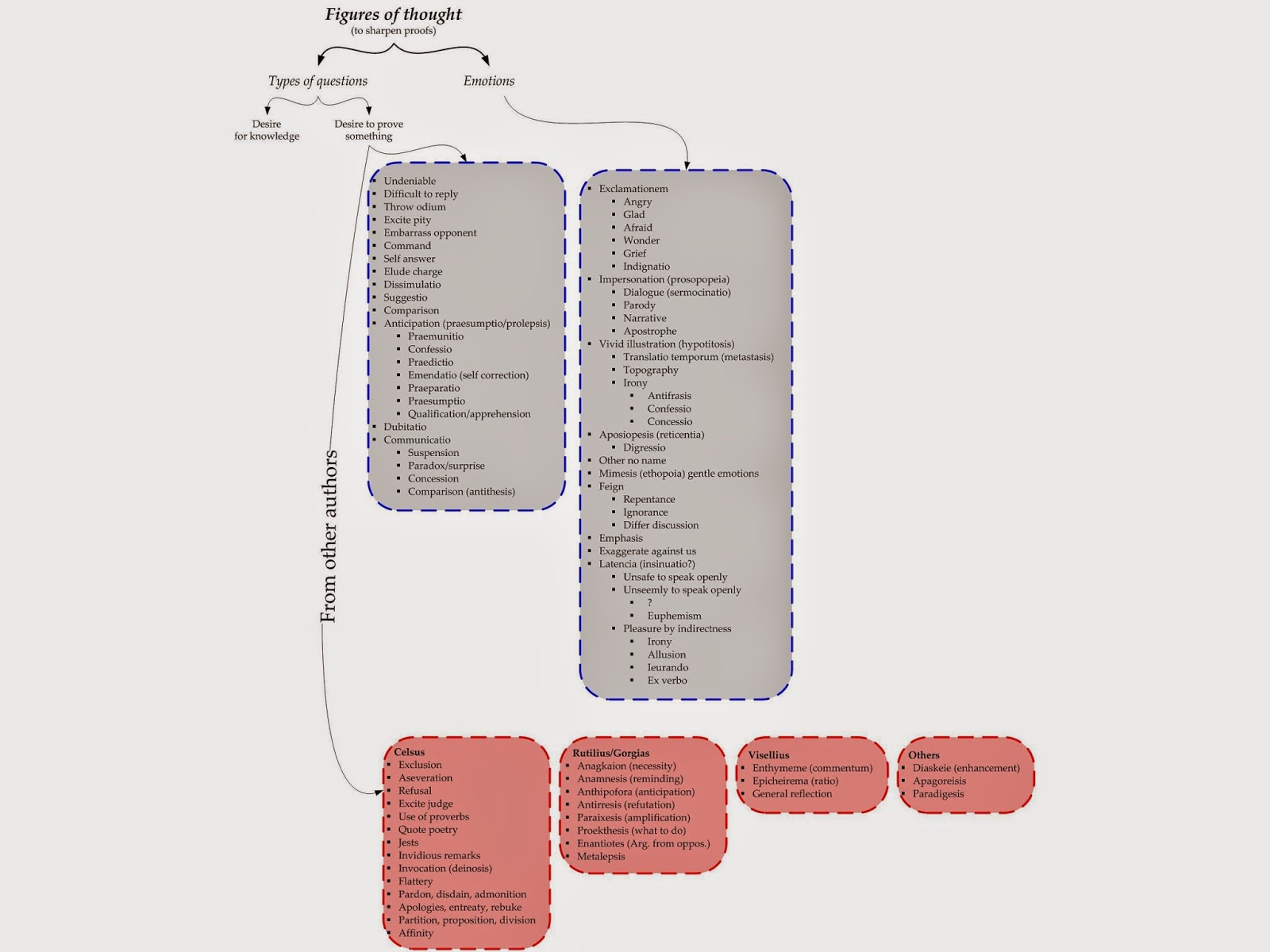
Showing posts with label Quintilian. Show all posts

P. Ramus on Method - 2

Ramus proposes two types of Method

  1. Natural: which orders discourse in descending level of generality. Intended for Science. In this Ramus is not at odds with Quintilian who also advocated for the "natural" method. See here for the text.
  2. Prudential: which orders discourse suitably to teach the audience effectively. Intended for lay audiences.
These quotes are taken from McIlmaine's translation, who obliterates prudential method almost completely! (Howell, 183)

  • Method is the intelligible order (dianoia) of various homogeneous axioms ranged one before the other according to the clarity of their nature, whereby the agreement of all is judged... As in the axiom one considers truth and falsity, and in the syllogism consequence or lack of consequence, so in method one sees to it that what is of itself clearer precedes (praecedeat), and what is more obscure follows, and that order and confusion in everything is judged.... Thus method proceeds (progreditur) without interruption from universals to singulars. By this one and only way one proceeds (proceditur) from antecedentes entirely and absolutely more known to the clarification of unknown consequents.
  • Method is disposition (methodus est dispositio) by which, out of many homogeneous enunciations, each known by means of a judgment proper to itself [axiom] or by the judgment of syllogism, that enunciation is placed first which is first in the absolute order of knowledge [order of cognition], that next which is next, and so on. Thus there is a perpetual progression from universals to singulars.
Milton, (Logica, 473 Columbia Ed.) explains the relationship that there is between axiom, syllogism and method:
So as truth or falsity is seen in the axiom, in the syllogism consequence and inconsequence, so in method care is taken that what is clearer in itself should precede, what is more obscure should follow (dispositio); and in every way order and confusion are judged (judgment). Thus the first in absolute idea of the homogeneous axioms is disposed in the first place, the second in the second, the third in the third, and so on.

Reditus ad propositum

The diggresio is an aversio ad rem. The return to main topic after a digressio. Involves a 'continual ongoing consciousness and articulation of structure'.

From Sonnino, 156:

Cicero: a neat and elegant return to the main theme after a digression
Wilson: When we have made a digression, we may declare our return... we will now keep us within our bounds.

In Chaucer:

"There as I left I will again begin" in line 35 of Knight's Tale

Another example in John Knox:

"Now to your argument...." and "but omitting..."

The antecedent to the digression would be, according to Quintilian (9.2.55-57), the aposiopesis which in some instances could be used as a transitional device to introduce a digressio or announce an impromptu change in the line of argument. (See The Princeton Encyclopedia of Poetry and Poetics: 4th Ed., p. 61).

Other candidates to announce a digressio are (from Sonnino, 247-248):
  • Metabasis (Transitio): See the nice entry with examples from Peacham's The Garden of Eloquence here.
  • Apostrophe
  • Prosodiasaphesis
  • Interjectio
  • Improvisum
References:

Sonnino, L. (1968) A Handbook of Sixteenth Centrury Rhetoric. Barnes & Noble,
Holton, A. (2008) The Sources of Chaucer's Poetics. Ashgate. 74ff
Farrow, K. (1990) Humor, Logic, Imagery and Sources in the Prose Writings of John Knox. Studies in Scottish Literature. 25, 1, 154-175. here
Elliot, R. (1919) Transition in the Attic Orators. The Collegiate Press. here

Arguments convince nobody (except mathematicians, some engineers, and some physicists)

Image result for borgesGeniuses invent their predecessors, said Borges. And he himself, maybe invented an argument out of Emerson, and put it at the base of an important observation: arguments, syllogisms, enthymemes, epicheiremes, convince nobody. Now, this might be the Positivists nightmare (yes, including the Earl of Russell) for, didn't they dogmatize that everything, if it was to be scientifically accepted, had to be proven by logic (whatever version we might choose)? And in that iconoclastic impulse, they threw away Metaphysics and Theology.

Yet, years later, when nobody seriously considers Positivism a feasible Philosophy, and after Godel proved Hilbert and his (unwanted?) disciple Russell to be completely wrong insofar the role that they had envisioned for Logic, Borges posits that arguments convince nobody, but Poetry, Parables, and the like do.

An excerpt of the interview that the philosopher Denis Dutton made to Borges explains the idea:

Dutton: Do you think that it is possible then for a story to represent a philosophical position more effectively than a philosopher can argue for it?

Borges: I have never thought of that, but I suppose you’re right, Sir. I suppose you — yes, yes, I think you’re right. Because as — I don’t know who said that, was it Bernard Shaw? — he said, arguments convince nobody. No, Emerson. He said, arguments convince nobody. And I suppose he was right, even if you think of proofs for the existence of God, for example — no? In that case, if arguments convince nobody, a man may be convinced by parables or fables or what? Or fictions. Those are far more convincing than the syllogism — and they are, I suppose. Well, of course, when I think of something in terms of Jesus Christ. As far as I remember, he never used arguments; he used style, he used certain metaphors. It’s very strange — yes, and he always used very striking sentences. He would not say, I don’t come to bring peace but war — “I do not come to bring peace but a sword.” The Christ, he thought in parables. Well, according to — I think that it was Blake who said that a man should be — I mean, if he is a Christian — should be not only just but he should be intelligent ... he should also be an artist, since Christ had been teaching art through his own way of preaching, because every one of the sentences of Christ, if not every single utterance of Christ, has a literary value, and may be thought of as a metaphor or as a parable.
and in a Conference at Harvard Borges observed:
"Had the poet said so in so many words, he would have been far less effective. Because, as I understand it, anything suggested is far more effective than anything laid down. Perhaps the human mind has a tendency to deny a statement. Remember what Emerson said: arguments convince nobody. They convince nobody because they are presented as arguments"
Postscript:

I believe that right in this observation of Borges, there is the solution to the riddle of argumentation. No doubt that Quintilian said that a good orator should be ultimately be a good man. The good man will craft his arguments to persuade rightly.

Borges asserted in his Guayaquil the power of the person over dialectics
"the power lay in the man, not in the dialectic."
"if one prevailed, it was because he possessed the stronger will, not because of dialectical games. As you see, I have not forgotten my Schopenhauer."
"Words, words, words. Shakespeare, the unparalleled master of words, held them in contempt."
References.

Mualem, S. () Borges and Plato: A Game with Shifting Mirrors.
Borges (2000) This Craft of Verse. Harvard


What's the difference (and use) of Tropes and Schemes?

There are many Figures of Speech. But the challenge is to figure out when, where, and how to use them to convey maximum efficacy to the speech.

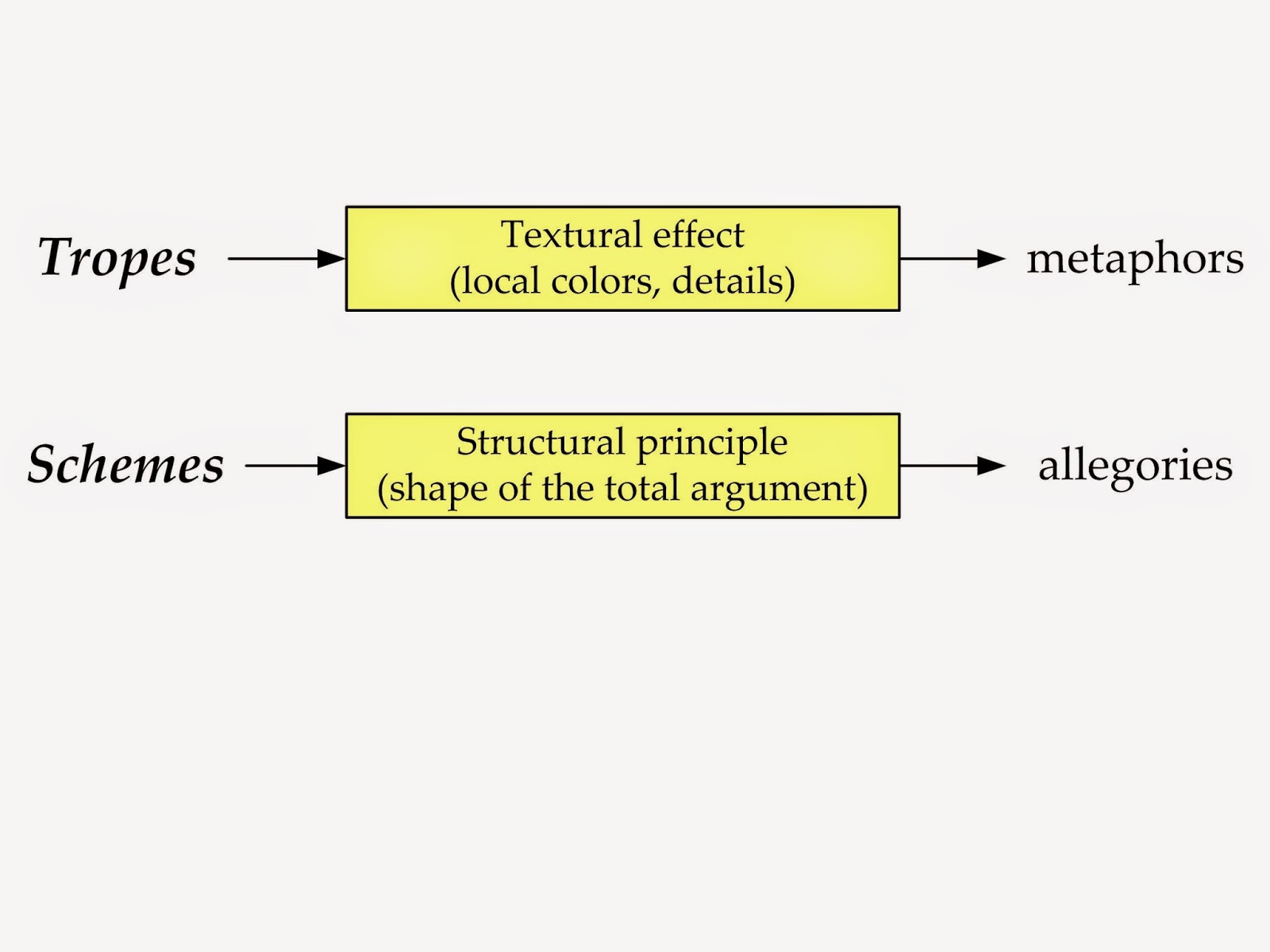
The author of the Rhetoric entry in the Enc. Brit. (5th, Vol. 26, p. 804)  offers a useful functional distinction of tropes and schema:
Ancient rhetoricians made a functional distinction between trope (like metaphor, a textural effect) and scheme (like allegory, a structural principle). To the former category belong such figures as metaphor, simile (a comparison announced by "like" or "as"), personification (attributing human qualities to a nonhuman being or object), irony (a discrepancy between a speaker's literal statement and his attitude or intent), hyperbole (overstatement or exaggeration) or understatement, and metonymy (substituting one word for another which it suggests or to which it is in some way related--as part to whole, sometimes known as synecdoche).
To the latter category (scheme) belonged such figures as allegory, parallelism (constructing sentences or phrases that resemble one another syntactically), antithesis (combining opposites into one statement--"To be or not to be, that is the question"), congeries (an accumulation of statements or phrases that say essentially the same thing), apostrophe (a turning from one's immediate audience to address another, who may be present only in the imagination), enthymeme (a loosely syllogistic form of reasoning in which the speaker assumes that any missing premises will be supplied by the audience), interrogatio (the "rhetorical" question, which is posed for argumentative effect and requires no answer), and gradatio (a progressive advance from one statement to another until a climax is achieved).


Quintilian: Rules of thumb for a proper "Dispositio"

Remember that after inventio comes dispositio:

... in speaking, however abundant the matter may be, it will merely form a confused heap unless arrangement [dispositio] be employed to reduce it to order and to give it connexion and firmness of structure. Institutio, VII, Pr.

In Russell translation:

But just as it is not enough in erecting a building simply to collect the stone and the timber and the other building materials, unless the hands of craftsmen are put to work to dispose and assemble them, so also in speaking, however rich the material, it will be nothing but a random accumulation unless Disposition organizes it, links it all up, and binds it together. Institutio, VII, Pr.

Watson translates confused mass.

Book VII, Pr. 

I used also to employ the following method [for arrangement]. I went back from the ultimate species (which generally contains the vital point of the case) to the first general question or descended from the genus to the ultimate species ... But in our search for such questions we follow an order quite different from that which we employ in our actual speaking. For that which as a rule occurs to us first, is just that which ought to come last in our speech... We must not be therefore be content with the thoughts that first offer themselves, but should press our inquiry further till we reach conclusions... Consequently after surveying our opponent's proposition, an easy task, we should consider, if possible, what it is most natural to answer first. And, if we imagine the case as being actually pleaded and ourselves as under the necessity of making a reply, that answer will probably suggest itself. On the other hand, if this is impossible, we should put aside whatever first occurs to us and reason with ourselves as follows: "What if this were not the case?" We must then repeat the process a second and a third time and so on, until nothing is left for consideration. ... The rule that we should descend from the common to the particular is much the same, since what is common is usually general. ... I used also to note down separately whatever was admitted both by my opponent and myself, provided it suited my purpose, and not merely to press any admissions that he might make, but to multiply them by partition, ... I used also, with reference to the whole material of the case, to do what I have already mentioned as being done with arguments, namely, after first 
setting forth all the facts without exception, I then disposed of all of them with the one exception of the fact which I wished to be believed. .. Let us therefore consider every possible point; for thus we shall discover what is the best line for us to pursue, or at any rate what is least bad

References
here

Rem tene verba sequentur

  • Cato the Elder: "rem tene, verba sequentur"- when you have the subject, words will follow. (Jordan 80) 
  • Horace: "verbaque provisam rem non invita sequentur" - Once supply the thought, and words will follow as swift as soon as sought. (Horace, Ars 311 in Quintilian Inst. 1.5.2).
  • Dionysius of Halicarnassus: "toutou de aition, oti ou tois onomasi douleuei ta pragmata par' auto, tois de pragmasin akolouthei ta onomata- The reason...is that he does not make his subject the slave of his words, but makes the words conform to the subject. (Lys. 1)
  • Quintilian: "Omnis autem oratio constat aut ex iis quae significantur aut ex iis quae significant, id est rebus et verbis" - Every speech however consists at once of that which is expressed and that which expresses, that is to say of matter and words (Instituto III, v, 1, p. 397)
  • Moreover, "orationem porro omnem constare rebus et verbis: in rebus intuendam inventionem, in verbis elocutionem, in utraque conlocationem, quae memoria complecteretur? actio commendaret." - ... every speech is composed of matter and words, and that as regards matter we must study invention, as regards words, style, and as regards both, arrangement, all of which it is the task of memory to retain and delivery to render attractive. (Inst. viii, Pr.6, 179ff)
  • Quintilian also warns: "For, as a rule, the best words are essentially suggested by the subject matter and are discovered by their own intrinsic light...And if we have to spend all our life in the laborious effort to discover words which will at once be brilliant, appropriate and lucid, and to arrange them with exact precision, we lose all the fruit of our studies" (Institutio, VIII. Pr. 21, 26)
  • There's two key parts in crafting a discourse, inventio (finding the elements of an argument) and dispositio (arrangement). Quintilian explains that: "...sic in dicendo quamlibet abundans rerum copia cumulum tantum habeat atque congestum, nisi illas eadem dispositio in ordinem digestas atque inter se commissas devinxerit" -  ...in speaking, however abundant the matter may be, it will merely form a confused heap unless arrangement be employed to reduce it to order and to give it connexion and firmness of structure. (Institutio, VII, Pr., vol 3. p. 3). 
    • Thus dispositio transforms the confused heap of argumentative loose elements into a persuasive and flowing whole. 
    • REM TENE = inventio, VERBA SEQUENTVR = dispositio
  • "To Ramus, dialectic was the theory of subject matter (i.e. rem) and form in communication, rhetoric the theory of stylistic (i.e. verba) and oral presentation." Howell 165.
  • Parenthesis: Luther said: Res et verba Philippus; verba sine re Erasmus; res sine verbis Lutherus: nec res, nec verba Carolostadius; Table talk DCCCII
  • Crousaz, "It is the thoughts themselves that are the basis of eloquence... It is the manner of thinking that creates beauty of style. It is a gross error to  make it depend either entirely or principally upon the expressions and turns. Whether you would instruct or move, these effects are owing to the things that the words signify, not to the words themselves. Art of Thinking, II 364-365, in Howell, Eighteen Century Logic, 324.
  • Collingwood said: 
    • "Here lies the difference between the desultory and casual thinking of our unscientific consciousness and the orderly and systematic thinking we call science. In unscientific thinking our thoughts are coagulated into knots and tangles; we fish up a thought out of our minds like anchor foul of its own cable, hanging upside-down and draped in seaweed with shellfish sticking to it, and dump the whole thing on deck quite pleased with ourselves for having got it up at all. Thinking scientifically means disentangling all this mess, and reducing a knot of thoughts in which everything sticks together anyhow to a system or series of thoughts in which thinking the thoughts is at the same time thinking the connexions between them. Logicians have paid a great deal of attention to some kinds of connexion between thoughts, but to other kinds not so much." An Essay on Metaphysics, 22
  • As a footnote, Vitruvius tells that symmetry: "is the appropriate agreement [conveniens consensus] of the elements of the work itself, a correspondence [responsus], in any given part, of the separate parts to the entire figure as a whole. Just as in the human body there is a symmetric quality of eurhythmies [symmetros es eurythmiae qualitas] expressed in terms of the cubit, foot, palm, digit, and other small units, so it is in perfect works. (de Architectura, i, ii, 4). "The precepts of symmetries".
  • And to summarize, as Lito Vitale argued when asked about the proper way of playing the piano: si vos no tenés nada que decir, por mas técnica que tengas, es como que estás a medio camino. See interview here (min 12:05).

See Calboli, G. (1995), Quintilian and Horace, Scholia ns 4, 79-100

Classification of Tropes by Quintilian

Here's the classification that Quintilian makes of the Tropes (Institutio VIII, vi). I'll add the definitions later:


Marcus Fabius Quintilianus - Institutio Oratoria

I regularly have to write many scientific papers. I have a decent bookshelf full of books on this topic. It was great my surprise though when I started reading Quintilian on how to organize a speech. I think that this book might well replace all the other, wordy, recipe-ish modern books.

Quintilian divides Oratory in three main types (p.397):
  1. Panegyric: p. 465-481.
  2. Deliberative (deliberativum): p. 483ss
  3. Forensic (iudiciale): (III, viii, 1) - 515ss
The forensic (iudiciale) kind of oratory is divided by Quintilian into five parts (III, viii - p.515):
  1. exordium (proemium)
  2. statement of facts (narratio)
  3. proof (probatio)
  4. refutation (refutatio)
  5. peroration (peroratio)
Furthermore, the parts of a (forensic) discourse are four for Quintilian (Irwin, 1929):
  1. Proemium or Exordium (IV, i - p.7-49): Purpose, procure the goodwill
  2. Narratio or Statement of Facts 
    1. Confirmatio: Verification (IV, III) - optional 
    2. Propositio - optional 
    3. Partitio - optional 
  3. Causae or Proofs: (constructive (proof) and destructive (refutation))
  4. Peroratio
Details:
  • Exordium (gr. proemium): It's the commencement of a discourse. The term was borrowed from the lyre players who perform an amenable prelude in order to win the favor of the audience. I might have whatever it takes "in order that the judge may give favorable hearing to our defence" (IV, ii, 27)
    • The sole purpose of the exordium is to prepare our audience in such a way that they will be disposed to lend a ready ear to the rest of our speech (IV, i, 5, p.9) by making the audience well-disposed/good will, attentive, and ready to receive instruction:
      • How to secure good will: from (1) persons, (2) case, (3) other
        1. Persons: (1) client, (2) lawyer, (3) opponent's advocate, (4) opponent - (IV, i, 4-7, p. 9ff)
          1. From Client (p.12): following points will be lightly touched, "not run to death":
            1. emphasize his worth
            2. commend his weakness
            3. set forth his merits
            4. sex, age, and situation (women, old men, children)
          2. From Lawyer (p.11)
            1. Create  impression that been forced to take case by force, honor. Avoid showing impression of meanness, spite, ambition, abusive, malignant, proud, or slanderous toward any individual.
          3. Against an opponent's advocate (p.11):
            1. speak of him in honorific terms: pretend to fear eloquence so that turns suspect to the judge.
            2. speak badly of him
          4. Against opponent (p.12): 
            1. power by envy; meannes by contempt; guilt by hatred.
        • Tricks for acquiring good will (p.23) and make people ready to receive instruction:
          1. rethorical expression of willing, detestation, entreaty, or anxiety. (p.23) if the judges thinks the case to be novel, important, scandalous, or sets a precedent.
          2. Stir hope, fear, admonition, entreaty, falsehood.
          3. Create the impression that the we won't keep them long but will stik to the point.
          4. Provide a brief and lucid summary (p.25).
    • Lenght of the Exordium: 
      • IMP: Should only indicate the points on which the orator proposes to speak.
      • Shouldn't expound, but propound.
    • On how to secure good will in different cases. Quintilian proposes that there are 6 kinds of causes (p.26-28):
      1. the honourable
      2. the mean
      3. the ambiguous or doubtful
      4. the extraordinary
      5. the obscure
      6. the scandalous
    • Parts of the Exordium. Some propose that it has 2 parts:
      • introduction:
      • insinuation:
    • Method to compose an Exordium (IV, i, 52 / p.35) consider: 
      1. ...what you have to say
      2. ...before whom
      3. ...in whose defense
      4. ...against whom
      5. ...at what time and place
      6. ...under what circumstances you have to speak
      7. ...what is the popular opinion on the subject
      8. ...what the prepossessions of the judge
      9. ...what we should deprecate or desire
    • e.g.
      • Might include the rebuttal of some allegations before going to the SoF. (IV, ii, 26) e.g. 
      • No fancy, or old words.
      • Indicates "what the completed picture is like to be".
      • Transition to Statement of Facts (IV, i, 79): Must be enunciated, although not abruptly. If the audience isn't notified, the first part of SoF is lost since the judge will not notice the transition. 
  • Narratio (Statement of Facts - SoF): Indicates the nature of the subject on which the audience/judge will have to give judgment.
      • Definition: it "consists in the persuasive exposition of that which either has been done, or is supposed to have been done, or, [as Apollodorus puts it], is a speech instructing the audience as to the nature of the case in dispute".
      • Importance: " there is no portion of a speech at which the judge is more attentive".
      • Length: if the case is brief, a short summary will do, the SoF isn't necessary. In a trial, only one part does it. A single sentence might be enough, "I say that Horatius stole the book". 
      • Qualities: Isocrates points that it should have these three qualities "lucid (clearness), brief, and plausible (credible, probable). 
        • Lucidity and clearness: 1) set forth our story in appropriate words, significant, free from meanness, not farfetched, nor unusual. 2) give a distinct account of facts, persons, times, places and causes. Give the impression of absolute truth (IV, ii, 39).
        • Brief: we might strive for conciseness (free from superfluous matter) , not brevity (omits things to be stated). So not saying less, bit not saying more than occasion demands.(IV, ii, 43). 
          • Avoid repetitions, tautologies, and diffuseness. SoF must be expeditious.
          • Conversely, guard against the obscurity which results from excessive abridgment. 
          • Say just what is necessary and sufficient. However, not the bare minimum to convey our meaning; for our brevity must not be devoid of elegance. Pleasure beguiles the attention, just as a picturesque and easy journey tires us less than a difficult shortcut." (IV, ii, 45-46). Too brief a statement becomes a confession. "Next we must put forth all our art either to shorten it or to render it less tedious"
          • Use interjections as a method to avoid tedium: e.g. something like "you have heard what happened before: now learns what follows". It provides a sense of closing previous remarks and prepares audience for a fresh start.
          • If SoF is long, add a summary at the end of as a reminder.
        • Credible (IV, ii, 52): 1) say nothing contrary to nature, 2) assign reasons and motives for the facts, 3) make the actors keep with the facts. "we must take care, first that our fiction is within the bounds of possibility, secondly that it is consistent with the persons, dates and places involved and thirdly that it presents a character and sequence that are not beyond belief"(IV, ii, 89).
          • Of course, avoid contradiction and inconsistency in the SoF.
      • Artifices
        • Digression (excursio), apostrophe (iudice sermo), argumentation. But these should be avoided in the SoF (IV, ii, 103-107)
        • Appeal to emotions: Cicero says that: "should be characterised by passages which will charm and excite admiration or expectation, and marked by unexpected turns, conversations between persons and appeals to every kind of emotion
        • Utmost adornment of grace and charm. How?
          • Choice of words (IV, ii, 117): 1) words: should be clear, not pompous but "steeped with meaning", 2) rhythm: unobtrusive but as attractive as possible, 3) figures: not from poetry, not contrary to current usage, 4) variety: designed to designed to relieve tedium, frequently changed to "relax the strain of attention".
          • Avoid repetitions, escape monotony of rhythm and stereotypes. 
        • Do not exhaust all of the emotional stock in the SoF.
        • Authority of speaker: it the reward of the manner of life, and style of eloquence. "everything must seem to spring from the case itself rather than the art of the orator", "the moment it is detected it ceases to be art." Don't be the slave of applause. (IV, ii, 127)
        • Repetition: touch lightly on some facts. It might be needed, but not always.
    • Confirmatio (Verification) (IV, iii). Digression: Sometimes it might be advantageous to digress on some topic after finishing the SoF. But it should be very brief, and not act as a wedge of a train of thought that otherwise must be kept continuous. Extremely cautious not to divert the attention gained by the SoF. It should be avoided most of the times. 
      • It involves emotional appeal.
      • The digressions might be given by: indignation (real or fictitious), pity, hatred, rebuke, excuse, conciliation, rebut invective, emotional 
      • Must eb part of the "texture of speech".
    • Propositio (IV, iv): it deals with 1) the definition of the charges, 2) enumeration of the charges, 3) rebuttals of charges against us, 4). It serves to " when we start to verify our statements he may realise that he has reached a fresh stage where he must begin to listen with renewed attention" (IV, iv, 9)
    • Partitito (IV, v): "enumeration in order of our own propositions, those of our adversary or both".
      • Purpose: to explain what we are going to say
      • Length: should be lucid, and clear, and brief
      • Resolution:
        • "Redundance as a rule occurs through our dividing into species when it would be sufficient to divide into genera, or through the addition of species after stating the genus." (IV, v, 27). e.g. "'I will speak of virtue, justice and abstinence.' But justice and abstinence are species of tile genus virtue." (genus = general, formed by species, formed by many differentia)
        • "avoid excessive minuteness and any suggestion of articulated structure in our partition". 
        • "If our divisions are too small, they cease to be limbs and become fragments, and ... detract from the authority of our speech. ... those who are ambitious ...to enhance the nicety and tile exhaustive nature of their division, introduce what is superfluous and subdivide things which naturally form a single whole. The result of their labours is, ... to diminish their importance, and after all is done and they have split up their argument into a thousand tiny compartments" (IV, V, 24-25)
      • Figures: “It has almost escaped me,” “I had forgotten,” or “You do well to remind me.”
  • Proofs (Causae): (IV, v)
    • Genus: Proofs
      • Genera: inartificial and artificial proofs
        • Species (of artificial proofs)
          1. indications (indicium): tekmeria (necessary), eikos (credible), semeion (not impossible).
          2. arguments: enthymeme, epicheireme, apodeixis
          3. examples: paradeigma (example: rethorical induction (epagoge)), parabolé (comparison), similes...
    • Artificial Proofs (V, viii): "wholly the work of art"
      1. Indications (indicium)
        1. tekmeria: these are indication from which there is no getting away (V, ix, 5). Some can be reversed, some cannot.
          • Future: > wounded man, will die.
          • Present: > high wind at sea, there must be waves.
          • Past: >  pregnant woman had intercourse.
        2. eikota: involve probabilities (non necessaria). Might not remove doubt by themselves but in conjunction with other indications.
        3. semeion (signumvestigium): sign, trace, symptoms such as weather related. "The force of such indications depends on the amount of extraneous support which they receive" (V, ix, 9).
      2. Arguments: 
        • Definitions
          • "is a process of reasoning which provides proof and enables one thing to be inferred from another and confirms facts which are uncertain by reference to facts which are certain"; "a method of proving what is not certain by means of what is certain".
          • "is that which provides proof" 
          • A warrant of credibility.
        • Sources of certainties 
          1. what is perceived by the senses.
          2. those things about which there is general agreement.
          3. things established by law or current usage.
        • Degrees of credibility: "it is with credibility that the great majority of arguments are concerned"
          1. highest: what usually happens: "father loves son"
          2. highly probable (propensius): "man in good health will be alive tomorrow".
          3. nothing against: 
        • Types of arguments:
          1. Enthymemata: Conclusion from incompatibles, or incomplete syllogism. 
          2. Epycheiremata: conclusion from consequents
          3. Apodeixis: A clear proof like those of the geometricians.
        • Places or Regions of Arguments (loci communes or koinoi topoi) (V, x, 20)
          1. Persons
          2. Things (and its accidents)
            1. causes, 
            2. place and 
            3. time 
              1. preceding, 
              2. contemporary and 
              3. subsequent), 
            4. from resources 
              1. instruments
            5. from manner 
            6. definition: genus, species, difference, property, elimination, division, beginnings, increase, consummation, likes, unlikes, contradictions, consequents, efficients, effects, results, and comparison
to be continued...