Showing posts with label Analogies. Show all posts

What's the difference (and use) of Tropes and Schemes?

There are many Figures of Speech. But the challenge is to figure out when, where, and how to use them to convey maximum efficacy to the speech.

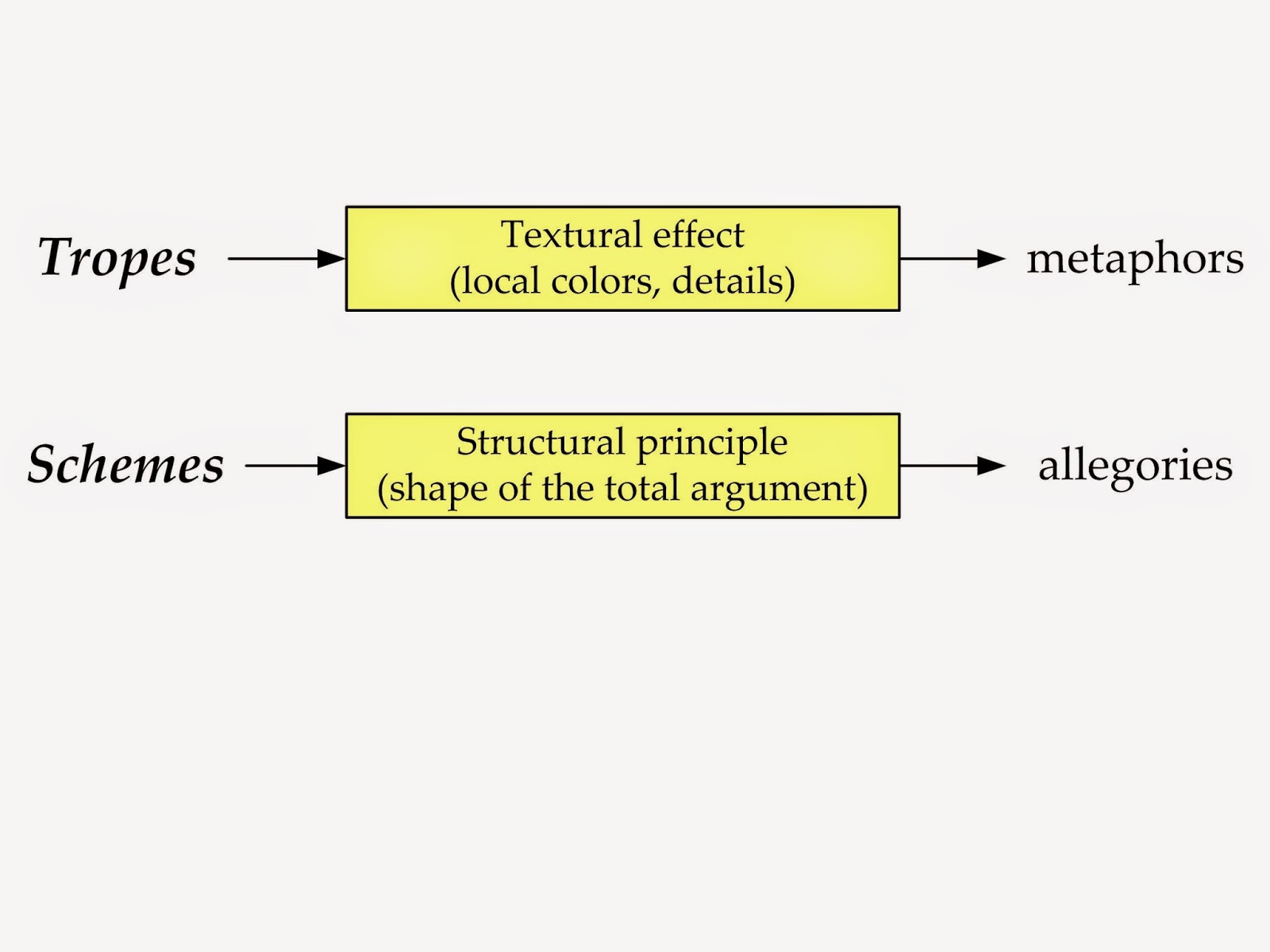
The author of the Rhetoric entry in the Enc. Brit. (5th, Vol. 26, p. 804)  offers a useful functional distinction of tropes and schema:
Ancient rhetoricians made a functional distinction between trope (like metaphor, a textural effect) and scheme (like allegory, a structural principle). To the former category belong such figures as metaphor, simile (a comparison announced by "like" or "as"), personification (attributing human qualities to a nonhuman being or object), irony (a discrepancy between a speaker's literal statement and his attitude or intent), hyperbole (overstatement or exaggeration) or understatement, and metonymy (substituting one word for another which it suggests or to which it is in some way related--as part to whole, sometimes known as synecdoche).
To the latter category (scheme) belonged such figures as allegory, parallelism (constructing sentences or phrases that resemble one another syntactically), antithesis (combining opposites into one statement--"To be or not to be, that is the question"), congeries (an accumulation of statements or phrases that say essentially the same thing), apostrophe (a turning from one's immediate audience to address another, who may be present only in the imagination), enthymeme (a loosely syllogistic form of reasoning in which the speaker assumes that any missing premises will be supplied by the audience), interrogatio (the "rhetorical" question, which is posed for argumentative effect and requires no answer), and gradatio (a progressive advance from one statement to another until a climax is achieved).


What makes a pattern a pattern?

I've been intrigued by the use of analogies, metaphors and schemas in our everyday thinking, in mathematics, in physics, and in engineering. Granted that we resort to all the above all the time in order to build our thoughts. Many philosophers of the modern age already proposed that all thinking, and consequently nature itself, were reducible to a set of few simple notions that upon some algebraic combination could form all of the available knowledge and nature laws. I already wrote about Leibniz and Descartes proposing such views. Today we may feel that those views were unwarranted extrapolations of some cases-where a given field rests upon few notions-into the generality.

However, there cases where the tenet holds! Now, circumscribing ourselves to those cases, I had this question: What makes a pattern a pattern? By pattern I mean that conceptual construct that will be resorted to frequently by us in order to explain, and/or build more elaborate pieces of reasoning.

Geometry is a fertile field for understanding this. A pattern might have these three characteristics:
  1. Regularity: sequences that repeat at constant/regular/predictable intervals of time, space, structure, etc.
  2. Simplicity: must be simple, short. Occam's razor applies here.
  3. Symmetry: the structural coherence upon some axis.
Any figure that doesn't have the above three cannot be a pattern. The most common geometrical figures-line, circle, triangle, square- are patterns. They have layers of pattern-ness: the first is the most obvious, the visual. There's another which is the association of straight lines, and even others as the relationship among figures.

There are more patterns, but that themselves are built upon simpler and more elementary patterns. They are related through laws of association-such as combination, harmonization, equation, parallelization-e.g. the platonic solids.

The Platonic solids:  tetrahedron, cube, octahedron, dodecahedron, icosahedron.

Figure Tetrahedron Cube Octahedron Dodecahedron Icosahedron
Based on: Triangle (3) Square (4) 3 Pentagon (5) 3
Coinciding lines (Assn. rule) 3 3 4 3 5
Faces 4 6 8 12 20

The number of faces is one of the most characteristics. But the other features contribute to the pattern. 

Thus the patterns are the fundamental cognitive categories that the mind resorts to to interpret all type of phenomena. Hence cognition comes to the use of analogies and metaphors to "make sense" of the observed. Therefore, "structuring" is the act of associating proto-patterns, or patterns among themselves to fit an observation.

Reasoning Symbolically by Analogy (beta version)

Analogy is a kind of similarity in which the same system of relations holds across different objects  (Gentner p.107)  ...
"the ability to carry out fluent, apparently effortless, structural alignment and mapping [is] a hallmark of human cognitive processing" (Gentner and Markman 1997, p. 53).

Assume that an element S, to be used in an analogy has, say, 4 properties, i,j,k,l. Each of these properties sufficiently define the element S. Let's represent it by:


In an analogy there are at least 2 elements to be compared. Say the other element is C with properties k,l,m,n.


To compare both elements in an analogy, let's define an analogy operator  which tells that both elements share properties k and l. i.e.


Result 1: The most basic result of an analogy is that both elements can be equaled only in the properties that they share. In the example, we can say that S is like C in k and l, only. Any other inference of the remaining properties of either element is not supported by the analogy and constitutes automatically in the fallacy of false analogy.

Another situation involves the assumption that "the predication is transitive across two analogies" (Lightbody and Berman, 2010). In other words, this involves 


However this does not always hold because each element has properties unlike the previous example. Let's propose another analogy with S


We want to check if P is like C since S = C and S = P. In order to investigate the feasibility of such deductive inference, we now need to determine if the "analogizers" overlap (i.e. the properties overlap)  in order to allow a deductive inference. However,


Since the "analogizers" are not equivalent, therefore any further deductive parallel between C and P is not valid, i.e.:


We can say nothing about the relationship between C and P because ther properties allow us not to move in that direction.

Result 2: In a crossed analogy, if the properties of the predicates do not overlap, then the deduction cannot be carried out. If this rule is violated, the Metaphoric Fallacy by Deductive Inference (MFDI) is incurred (Lightbody and Berman, 2010).


Yet another possibility easily extensible from previous results is that of comparing two analogies and infer something from the last one, like A = B as C = D. In this case we need to compare the analogy operators of both analogies and check what's overlapped, i.e.


therefore both analogies are not entirely comparable but only through the k property


We are then allowed to read that as: A is to B as C is to D, in the k property only. We can simplify the notation of the previous equation as:


This result is a generalization of Result 1. However, its the degree of certainty might be less because the joint properties of the analogy might have "degraded" since they come from two elements.


Features of the analogy operator.

The operator defines if an analogy is valid (feasibility), and on which properties is valid (extent). However there's more to it. These two features of the analogy aim at answering two questions:

Feasibility: Is the analogy at all possible?
Extent: Does the analogy capture the most important properties of the elements? On which grounds the analogy holds?
Strength: What's the descriptive power of the analogy? Is it weak, mild, strong? are the properties qualitative or quantitative?

While the analogy operator sheds light on the feasibility and the extent of the analogy, it does not say much about the strength of the comparison. An appraisal of the degree of match between the properties is needed to elucidate the strength of the analogy. The match can be qualitative or quantitative depending on the nature of the properties.


Uncertainty in the number of element properties

One can never be sure that has grasped all possible properties of an element in an analogy. This brings us to one of the main goals of analogies, to hypothesize about the presence of hidden properties in an element based on the analogy-based argument. On which grounds this can be valid? Symbolically


The question is if the (i,j) matched properties, afford the hypothesis that B's m is a "hidden property" of A. Can I hypothesize the presence of "m" as hidden given the strength of (i,j)? This inference is inductive and as such must be accompanied by a modal qualifier. Actually in Toulmin's scheme, (i,j) constitutes the warrants on which the syllogism stands, "m belongs to A" is the conclusion, and "A is like B" is the grounds. But a modal qualifier has to be there. 


Examples

As an example let's consider Phaedo's proof of the immortality of the soul:
1) "sleep" precedes "being awake" and also, "being awake" precedes "sleep"
2) "death" is like sleeping and "living" is like being awake.
3) "being awake" precedes "living"
4) Because of (1) to (3), therefore (4) can be completed by stating that: "dead" precedes "to live", i.e. everybody has been dead before being born.

Let's define the properties of each element. Sleep-Awake (SA) have: domain: temporal (is a natural process), function: circular (both precede each other), iconic: used as a metaphor. Symbolically:

the other element is the dyad dead-alive (DA) whose properties are: domain: timelessness (ts), function: what Socrates wants to prove, iconic: used as a metaphor, i.e.


The analogy only holds by its iconic property. However there are some problems for the analogy to hold. First the domain properties are in conflict. Seems hard to prove that what occurs in a natural process also holds in a metaphysical, timeless realm. In addition, the argument lacks of any modal qualifier to moderate the inductive inference that assigns the "circularity" of the sleep-awake process to the death-life process. The iconic property alone does not justify such an inference plus the heavy doubts cast by natural process holding in a metaphysical realm. Thus this constitutes a fallacy.


The number and importance of the dimensions that coincide between both candidates is an indicator of the "weakness" or "strongness" of the equivalence. If both elements shared a single element in common, then the equivalence would be possible, but only in that single dimension that both elements share. 
A more general case would be that one of the elements has more dimensions than the other, i.e.


References:

Gentner, D. (1998). Analogy. In W. Bechtel & G. Graham (Eds.), A companion to cognitive
science (pp. 107-113). Oxford: Blackwell

Gentner, D. and Markman, A. B. (1997): "Structure Mapping in Analogy and Similarity,"
American Psychologist, 52, 45-56.

"Word choice is guided by analogy"

In a lecture* Douglas Hofstadter gave a very interesting account about how the mind decides which word to choose in a given context to communicate/verbalize an inner concept. He points out that "...word choice is guided by analogy". The "lexical-item choice is always a fight". A fight between many instances, he means. So in order to communicate a particular idea our mind is presented with many word options to choose from. The best word will be chosen by an analogy-evaluation process, i.e. how well a given word matches what is to be expressed. Sometimes a single word "towers above the others" and is good enough to convey what we want to communicate. Some other times there are a bunch of competing words, and choosing from them turns into a mental "fight".
Hofstadter illustrates this fight by showing a histogram in which each word has a "likelihood" of matching the idea. If one words does, then it has the highest value and is chosen. If a couple of words do, then chances are that we by mistake blend them into a single word. This shows the mechanism that operates in our mind.

For further reading see:
  • Hofstadter, D. (2001), Analogy as the Core of Cognition in The Analogical Mind, Gentner, Holyak and Kokinov, Eds. The MIT Press.
  • Hofstadter, D. (2012), The Essence of Thought. Basic Books (to be released September 11, 2012)
_________
* Feb. 6, 2006 Presidential Lecture Stanford (http://www.youtube.com/watch?v=n8m7lFQ3njk)