Showing posts with label Modeling. Show all posts

The past is clay - All yesterdays , a dream

El pasado es arcilla que el presente

labra a su antojo. Interminablemente.


Borges 

Todos los ayeres, un sueño

Los conjurados (1985)
 

Measure what can be measured

Measure what can be measured. Incorrectly attributed to Galileo:

Cournot wrote:

La vraie physique a été fondée le jour où Galilée, rejetant des spéculations depuis si longtemps stériles, a conçu l’idée […] de préciser la forme générale à donner aux expériences, en leur assignant pour objet immédiat la mesure de tout ce qui peut être mesurable dans les phénomènes naturels. (Cournot De l’origine et des limites de la correspondance entre l’algèbre et la géométrie. Paris/Algier: Hachette, p. 375)

Translated:

True physics was founded the day when Galileo, rejecting the long sterile speculations, conceived the idea […] of specifying the general form to be given to experiments, assigning them as their immediate object the measure of all that can be be measurable in natural phenomena.

Similar to the more famous dictum by Kelvin:

In physical science a first essential step in the direction of learning any subject is to find principles of numerical reckoning and methods for practicably measuring some quality connected with it. I often say that when you can measure what you are speaking about, and express it in numbers, you know something about it; but when you cannot measure it, when you cannot express it in numbers, your knowledge is of a meagre and unsatisfactory kind; it may be the beginning of knowledge, but you have scarcely, in your thoughts, advanced to the stage of science, whatever the matter may be.

References:

  • Andreas Kleinert Der messende Luchs: Zwei verbreitete Fehler in der Galilei-Literatur. (https://link.springer.com/content/pdf/10.1007/s00048-009-0335-4.pdf)
  • Kelvin, ELECTRICAL UNITS OF MEASUREMENT. A Lecture delivered at the Institution of Civil Engineers on May 3, 1883" (https://archive.org/stream/popularlecturesa01kelvuoft#page/72/mode/2up)


Variations of the Observer Error

observer error: An error of observation or measurement due to failure of the observer to identify, measure accurately, or interpret some aspect of the phenomena that are being observed. This can have many reasons and causes, including careless or hasty measurements, faulty instruments, erroneous or illogical interpretation, and/or any of many possible sources of bias. It erodes the credibility of science when it occurs. Oxford Reference

Lucas critique argues that it is naive to try to predict the effects of a change in economic policy entirely on the basis of relationships observed in historical data, especially highly aggregated historical data. (Wiki).

Lucas critique (version 2): "Any statistical relationship will break down when used for policy purposes". Danielsson's corollary: A financial risk model breaks down when used for regulatory purposes.


Campbell's law: "The more any quantitative social indicator is used for social decision-making, the more subject it will be to corruption pressures and the more apt it will be to distort and corrupt the social processes it is intended to monitor."

Goodhart's Law: "Any observed statistical regularity will tend to collapse once pressure is placed upon it for control purposes." (Wiki)


Felix qui potuit rerum cognoscere causas

Felix qui potuit rerum cognoscere causas, atque metus omnis et inexorabile fatum subiecit pedibus strepitumque Acherontis avari.

"How blest the sage whose soul can pierce each cause
Of changeful Nature and her wondrous laws;
Who tramples fear beneath his foot, and braves
Fate and stern Death, and hell's resounding waves!"
⁠Sotheby's translation.

Happy is he who has discovered the causes of things and has cast beneath his feet all fears, unavoidable fate, and the din of the devouring Underworld.

Dichoso aquel, que con valor notable
las causas de las cosas supo claro,
que todo miedo, y hado inexorable
pisa, y el Reyno de Aqueronate avaro;
Christoval de Mesa's translation (1618)

Quan bienaventurado es el que pudo
Conocer los secretos de las cosas,
Y que ni al hado teme, ni amenazas,
Ni de Aqueronte avaro se da un pelo;
Juan de Guzman's translation (1586)

!Feliz aquel que las ocultas causas
Penetro de Natura, y sin cuidarse
De lo que traigan los futuros dias,
Cual polvo vano los temores tristes
Huella, y los ecos de Aqueronte avaro!
F. de Hidalgo y M. A. Caro's translation  (1897)

¡Feliz aquel a quien fue dado conocer
las causas de las cosas, y hollar bajo
su planta los vanos temores y el inexorable
hado y el estrépito del avaro Aqueronte!
Ochoa's translation (1869)

Techniques for Generating/Eliciting a Hierarchy or Network of Objectives

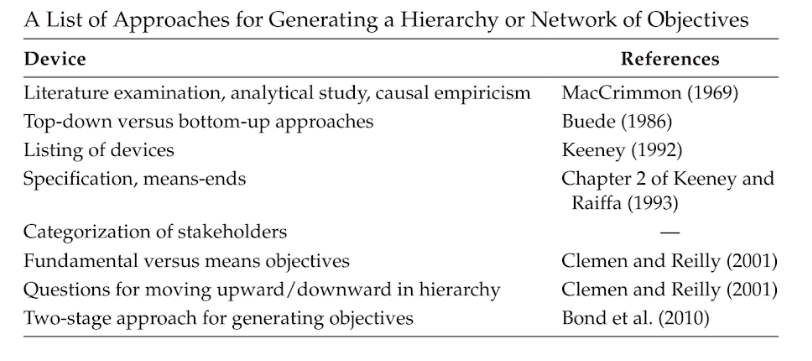
When structuring an ill-defined problem, eliciting the underlying objectives is fundamental. The task is subjective, but it certainly help to follow a formalized strategy. Evans p. 45 lists some existing approaches.


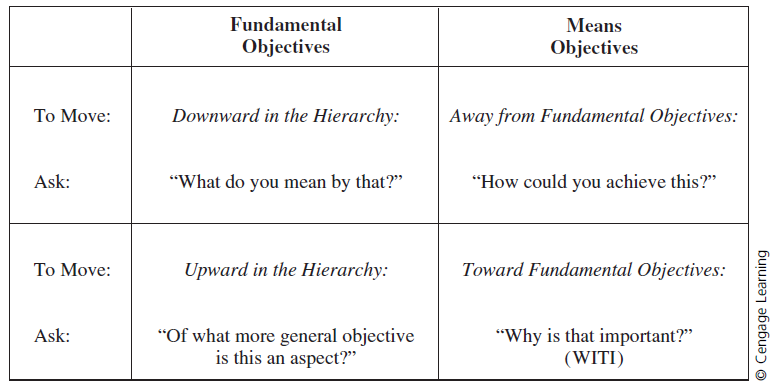
Clemen and Reilly (2017) p. 52 ask: "How do we first separate means and fundamental objectives and then construct the fundamental-objectives hierarchy and the means-objectives network?" and suggest four guiding questions, techniques, for organizing means and fundamental objectives:
  • Why Is That Important? (WITI)
  • How can this objective be achieved?
  • What do you mean by that?
  • Of what more general objective is this an aspect?

Buede (1986) proposes two structuring methods: top down and bottom-up approaches.
  • Top-down method: it's objective-driven (close to Keeney and Raiffa 1976); "the analyst begins by ascertaining the global objectives of the decision maker and proceeds to a value structure by subdividing the objectives, sub-objectives, and so forth until a final set of attributes is obtained."
  • Bottom-up approach: it's alternative-driven. "The analyst begins by questioning the decision maker for a reasonable set of alternatives, each of which might solve the problem. Once the alternatives are defined, the analyst generates a value structure by probing the decision maker for the major differences between the identified alternatives. The analyst then categorizes these differences into groups corresponding to objectives so that a hierarchical value structure can be systematically constructed. The identified differences comprise the set of attributes."
Manheim and Hall (1967) reject the method which hinge on too much mathematization of decision components (e.g. cost-benefit analysis, and utility theory: von Neumann and Morgenstern) because they "it tends to obfuscate the issues of choice by concealing them in the mathematics of utility". Which is reasonable. The method is:
  1. goal fabric analysis: list all the known goals for the project and then identifying the various relations among the goals.
  2. utilize the goal fabric analysis to rank the alternatives. This entails mapping each new alternative onto the goal fabric (i. e., predicting the performance of the alternative with respect to some of the goals) and then, using this mapped information and the structure of the goal fabric, comparing the new alternative with one previously ranked, to fit the new one into the ranking.
"The method operates on only two alternatives at a time. Any attempt to formulate a list of goals runs into problems of consistency, overlap and varying degrees of detail of the goals. These problems are usually approached by trying to state all the goals in a uniform way. In the method we propose, however, this is precisely what is not done: the list of goals can contain overlap and different degrees of detail. We propose analyzing the list to identify explicitly all the relations among these "non-uniform" goals. The goal analysis is intended to structure the goals by identifying the relations among them that are relevant to evaluation of the alternatives." There are four relations of importance (the first two guide expansion of the goals list in order to clarify the vague goals)
  1. specification: entails explaining in more detail what we mean by the general goal. 
  2. means-end: describes how a goal can be accomplished
  3. value-wise dependence: are those goals that can be evaluated only in conjunction with other goals.
  4. value-wise independence: can be evaluated on their own, without regard to any other goals
Reference
Evans, G. (2017) Multiple Criteria Decision Analysis for Industrial Engineering. CRC.
Clemen and Reilly (2014) Making Hard Decisions with DecisionTools. CENGAGE
Keeney (1992), Value Focused Thinking. Harvard, p. 57ff
Keneey and Raiffa (1976) p. 31ff
Buede (1986) Structuring Value Attributes. Interfaces, 16. 2
Manheim and Hall (1967) Abstract representations of goals. MIT

the mark of an educated man...

Our discussion will be adequate if it has as much clearness as the subject-matter admits of, for precision is not to be sought for alike in all discussions, any more than in all the products of the crafts. Now fine and just actions, which political science investigates, admit of much variety and fluctuation of opinion, so that they may be thought to exist only by convention, and not by nature. And goods also give rise to a similar fluctuation because they bring harm to many people; for before now men have been undone by reason of their wealth, and others by reason of their courage.

We must be content, then, in speaking of such subjects and with such premisses to indicate the truth roughly and in outline, and in speaking about things which are only for the most part true and with premisses of the same kind to reach conclusions that are no better. In the same spirit, therefore, should each type of statement be received; for it is the mark of an educated man to look for precision in each class of things just so far as the nature of the subject admits; it is evidently equally foolish to accept probable reasoning from a mathematician and to demand from a rhetorician scientific proofs. Nicomachean Ethics, I, 3.

and in Latin (secoind paragraph)

In tradenda civili scientia, non agendum esse demonstrationibus accuratis, quia id subjectum eius non permittit

(I don't like this Latin translation by William Wilkinson 1820 too much - it's very convoluted)

Ergo satis erit, si, cum de rebus et ex rebus ejusmodi verba facimus, rudem quandam veri formam adumbremus: et cum de rebus, quae plurimum eveniunt, atque ex talibus disputationem instituimus,
talia quoque concludamus. Eodemque modo quaecunque ab alio dicuntur accipi probarique debent; est enim hominis probe instituti tantam in unoquoque genere subtilitatem desiderare, quantam rei ipsius natura recipit; nihil enim videtur interesse, utrum mathematicum rationibus ad persuadendum ac commodatis utentem feras, an ab oratore demonstrationes postules.

This one by Carolus Zell (better)

Satis itaque erit, si, cum de ejusmodi rebus ex rationibus item ejusmodi explicatio instituatur, rudi quadam et crassa forma verum declaremus; satis item, si (cum et derebus, quae plerumque eveniunt, et vero etiam ex talibus rationibus disputationem instituamus) ad talem quoque modam concludamus. Εodem autem modo etiarti accipi oportebit, quae hic dicentur. Εst enim bene instituti hominis, tantam in unoquoque genere disputationis subtilitatem desiderare, quantam rei ipsius fert natura. Ut enim ridiculus sit, qui mathematicum probabilibus rationibus ntentem probet: ita is quoque, qui ab ora tore demonstrationes postulet.