
"The Enthymeme is a (rhetorical) syllogism". Aristotle, Reth. II, 22
"Rhetoric may be defined as the faculty of discovering the possible means of persuasion." Aristotle, Reth. I.2.1
Labels
Philosophy
(28)
Logic
(22)
Probability
(21)
Argumentation
(20)
Ramus
(20)
Literature
(15)
Assumptions
(14)
Handouts
(11)
Mathematics
(11)
Metaphors
(11)
Quotes
(11)
Matlab
(10)
Tropes
(10)
Method
(9)
Quintilian
(9)
Induction
(8)
Modeling
(6)
Book Reviews
(5)
Collingwood
(5)
Physics
(5)
Problem Structuring
(5)
Analogies
(4)
Historiography
(4)
System
(4)
Aphorisms
(3)
Classical
(3)
Evidence
(3)
Fallacies
(3)
People
(3)
Religion
(3)
Transitions
(3)
Decision Making
(2)
Dynamic Programming
(2)
GIS
(2)
Linear Programming
(2)
Poetry
(2)
Sayings
(2)
Toulmin
(2)
Writing
(2)
economics
(2)
Art
(1)
Bach
(1)
Policy
(1)
Regression
(1)
Risk
(1)
Showing posts with label Book Reviews. Show all posts
Review of "Dynamics Programming: a practical introduction" by D.K.Smith
I checked out the book from my university library to learn a little bit about dynamic programming. The book is very attractive because it's very concise (156 pages). For me the main merit of the book consists in introducing the reader to some of the most common problems tackled with dynamic programming. The main drawback is the notation, which is not straightforward.Chapter 1 explains clearly what dynamic programming is about and when it is helpful.
Chapter 2 introduces the stagecoach problem and the general shortest route problem.
Chapter 3 explains the knapsack problem and some other problems derived from this one. I have written another post with an elementary code to solve a knapsack problem. See here.
Chapter 4: ....
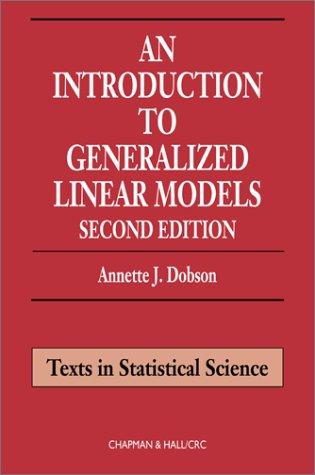
Review of "An Introduction to Generalized Linear Models, 2nd Edition (Chapman & Hall/CRC Texts in Statistical Science)
This is a wonderful introductory text to Generalized Linear Models (GLM). The text is crystal clear, concise and practical. There are enough illustrations to explain the concepts. The author does a great job in showing step by step the unity of many statistical techniques that otherwise are often taught unrelated in classrooms. The book helps to visualize the techniques as part of a coherent, interrelated theoretical system. One topic that I didn't find well explained and linked to the whole system is ANOVA in Ch. 6.Below there are some book exercises solved in Matlab:
Example 4.2: Pressure Vessels. Data is described by a Weibull distribution. Find the parameters of the distribution with the log-likelihood method.
>> data = [1051 1337 1389 1921 1942 2322 3629 4006 4012 4063 4921 5445 5620 5817 5905 5956 6068 6121 6473 7501 7886 8108 8546 8831 9106 9711 9806 10205 10396 10861 11026 11214 11362 11604 11608 11745 11762 11895 12044 13520 13670 14110 14496 15395 16179 17092 17568 17568];
>> [phat,pci] = mle(data,'distribution','wbl','ntrials',4);
>> phat = [9906.04877603439 2.01497978979166]
pci =
8564.07301904226 1.59974255374879
11458.3098643578 2.53799809460243
Example 4.4: Poisson regression example. The proposed function is Poisson, and the link function is identity. Basically, fit a regression line of the form
>> X = [-1 -1 0 0 0 0 1 1 1];
>> Y = [2 3 6 7 8 9 10 12 15];
>> [B DEV] = glmfit(X,Y,'poisson','link','identity');
>> B = [7.45163328911152 4.93530039799631]
DEV = 1.89465033525567
Interestingly the deviance of a gamma function is 0.25. Therefore Gamma might be a better model.
Example 7.2:
Fit a GLM to binomial data p. 119. The solution in Matlab is:
1.6907 59.0000 6.0000
1.7242 60.0000 13.0000
1.7552 62.0000 18.0000
1.7842 56.0000 28.0000
1.8113 63.0000 52.0000
1.8369 59.0000 53.0000
1.8610 62.0000 61.0000
1.8839 60.0000 60.0000
col1 = Dose (xi), col2 = #of bettles (ni), col3 = #beetles killed (yi). So
>> b = glmfit(xi,[yi ni],'binomial','link','logit');
b =
-60.7175
34.2703
>> xfit = glmval(b,D(:,1),'logit');
>> plot(D(:,1),xfit,'r')
Using another link functions, Replacing logit by 'probit', or 'comploglog', the best is cpmploglog, i.e. extreme value. The deviance has to be less than X2(N-p) = X2(8-2). In Matlab is
>> chi2inv(0.95,6) = 12.59. The Extreme Valur deviance is 3.44 as opposed to 11.23 of the logit.
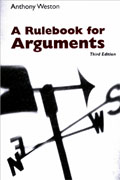
Review of: "A Rulebook for Arguments"
- Non-Deductive Arguments: which includes arguments by example, analogy, authority and about causes.
- Deductive Arguments: which are the classical schemes, i.e.: Modus Ponens, Modus Tollens, Hypothetical Syllogism, Disjunctive Syllogism, Dillema, Reductio ad absurdum, and finally a practical application of many of the above.
- Composing an Argumentative Essay: which is very useful. Actually I got more from this short account than from other book devoted entirely writing papers! there's finally a list of fallacies.
Pros: It's a nice book to keep handy. Its conciseness and careful writing make it useful.
Cons: It consistently uses the topic of the existence of God in the examples; most of the times, to deny it. I think this is unnecessary. (BTW, the proof in p.79 by David Hume, is naive).
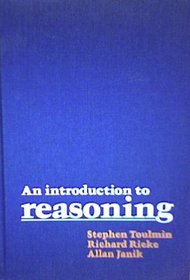
Review of: "An introduction to reasoning"
Written by Stephen Toulmin, a renowned British philosopher, R. Rieke, (professor of communication at Utah) and A. Janik (philosopher at Innsbruck), this book proposes an approach to the enthymeme that starts from the conclusion, moves towards the premises and also assigns a degree of uncertainty to the conclusion. This book is not so much to be read, but to be studied. The only way to take advantage of the powerful approach presented is to apply it to concrete situations. The following summary of the entire approach is offered in page 27:"The claims involved in real-life arguments are accordingly, well founded only if sufficient grounds of an appropriate and relevant kind can be offered in their support. These grounds must be connected to the claim, by reliable, applicable warrants, which are capable in turn of being justified by appeal to sufficient backing of the relevant kind. And the entire structure of argument put together out of these elements must be capable of being recognized as having this or that kind and degree of certainty or probability and as being dependent for its reliability on the absence of certain particular extraordinary, exceptional, or otherwise rebutting circumstances."
![]() |
| Fig. 1: Diagram of the complete argument process (from Toulmin et al., 1979) |
- Claims (Conclusion)
- Grounds (Premises)
- Warrants (Reasoning from Premises to Conclusion)
- Backing (demonstrate that the warrant process is sound and relevant)
- Modal qualifiers (indicates the reliance of the claims based on quality of grounds and warrant), like probably, presumably, etc.
- Rebuttal: exceptions for which the claim cease to hold.
Part II of the book explains all these steps in detail, with too much examples I might say. In page 78, the authors explain the structure of the argument (Fig.1):
"Given grounds, G, we may appeal to warrant, W (which rests on backing, B), to justify the claim that C—or, at any rate, the presumption (M) that C—in the absence of some specific rebuttal or disqualification( R)."My "rule-of-thumb" for the model is:
G, therefore M-C because W, as shown by B, unless R.Part III of the book is perhaps the most juicy part. It discusses rational merits of arguments, cross-purposes, adversary/consensus procedures, when & how to raise an argument, classification or arguments (analogy, generalization, cause, sign, dilemmas), fallacies all in the context of the scheme in Fig. 1.
Part IV, applies the reasoning scheme to special fields. I didn't find anything really new in the science part.
An idea
A question that came to my mind is: can we follow a "recipe" to build an argument and still be creative? Nobody will argue that a great deal of creativity is needed to get the right premises or warrants. However, I thought of an approach that might appeal to people not very fond of recipes.
Let's suppose that in an unconscious level our mind deals with arguments in the same way the mentioned pattern, or another similar, does. Let's also consider the possibility that, under some circumstances, the following of a fixed recipe to build an argument might interfere with the creativity involved in the process of connecting the different elements. So let the ideas flow freely. Do a brainstorming free of any constraints of classification or order and get as much ideas as possible to support a claim or join grounds to a claim. Once there isn't any new ideas brought, then the organization must take place. It's precisely at this stage that we take advantage of the system in Fig. 1 and plug these ideas into all of its boxes. This exercise might have a twofold benefit, 1) by organizing the ideas will, for sure, shed new insights of the argument; 2) Creativity is not blocked and can produce freely, even linking to some other problems, etc. Once all ideas are organized and some new insights has been acquired, we might feel that we want to iterate and produce another brainstorming with the newly acquired insights, plug into the pattern and so on, until we arrive at an argument configuration that is acceptable.
My opinion about the book.
The book might have too much examples in the text for some readers like me, mostly in the first part. I guess that some examples might be safely removed without any loss of clarity.
The argument scheme presented is fascinating. It explains and connects concepts that lie scattered in our heads, and organizes them as a system. And a system is a very powerful tool. I have applied the scheme to organize a scientific paper, and it has really helped me a lot. I plan to read the book again.
(to be continued...)
Subscribe to:
Posts (Atom)